
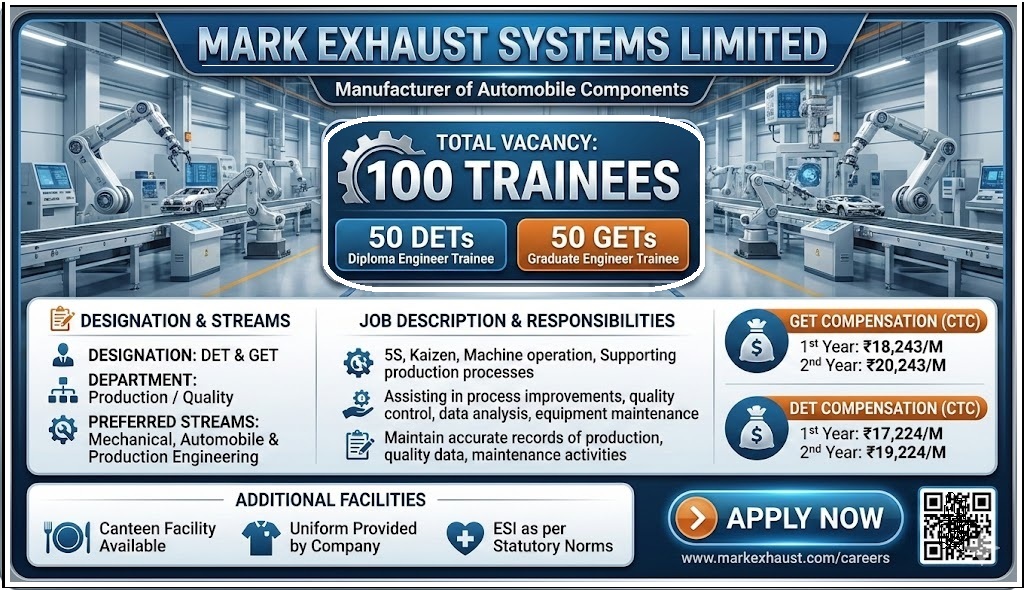
Mark Exhaust Systems Limited Hiring: 100 Diploma & Graduate Engineer Trainees (DET / GET)
Mark Exhaust Systems Limited, a reputed manufacturer of automobile components, is inviting applications from young and energetic engineering candidates for large-scale trainee hiring. This is an excellent opportunity for fresh diploma and graduate engineers who want to build a strong foundation in automotive manufacturing, production operations, and quality systems within a professional industrial environment.
Company Overview – Mark Exhaust Systems Limited
Mark Exhaust Systems Limited is a well-established organization in the automobile components manufacturing sector. The company is known for its robust production systems, quality-driven processes, and continuous improvement culture. Working at Mark Exhaust Systems offers hands-on exposure to modern manufacturing practices, shopfloor excellence, and long-term career growth in the automotive industry.
Current Openings: DET & GET
Total Vacancies:
- 50 – Diploma Engineer Trainees (DET)
- 50 – Graduate Engineer Trainees (GET)
Industry Type:
Automobile Components Manufacturing
Department:
- Production
- Quality
Designation:
- Diploma Engineer Trainee (DET)
- Graduate Engineer Trainee (GET)
Preferred Educational Streams
Candidates who have completed or are completing their education in the following streams are encouraged to apply:
- Mechanical Engineering
- Automobile Engineering
- Production Engineering
Both freshers and candidates with basic shopfloor exposure can apply.

Job Description & Responsibilities
As a DET / GET at Mark Exhaust Systems Limited, selected candidates will be trained and involved in core manufacturing and quality activities, including but not limited to:
Production & Shopfloor Support
Supporting day-to-day production processes
Assisting in machine operations and manufacturing activities
Understanding workflow, cycle time, and productivity improvement
Quality & Continuous Improvement Activities
Implementation and maintenance of 5S and Kaizen initiatives
Supporting quality control activities and inspection processes
Participating in process improvement and waste reduction projects
Process & Data Management
Assisting in data collection and basic data analysis
Maintaining accurate records of production, quality checks, and process parameters
Supporting documentation related to equipment and process performance
Equipment & Maintenance Support
Assisting in basic equipment handling and maintenance activities
Coordinating with maintenance and quality teams for smooth operations
This role provides strong hands-on exposure to automotive manufacturing systems and prepares trainees for future technical and supervisory roles.
Compensation Structure
Graduate Engineer Trainee (GET)
- 1st Year CTC: ₹18,243 per month
- 2nd Year CTC: ₹20,243 per month
Diploma Engineer Trainee (DET)
- 1st Year CTC: ₹17,224 per month
- 2nd Year CTC: ₹19,224 per month
Additional Benefits & Facilities
- 🍽️ Canteen Facility Available
- 👕 Uniform Provided by Company
- 🏥 ESI Coverage as per Statutory Norms
Why Join Mark Exhaust Systems Limited?
- Large-scale hiring with structured training
- Exposure to automotive production and quality systems
- Stable manufacturing environment
- Opportunity to grow with a reputed automobile component manufacturer

How to Apply
Interested and eligible candidates can send their updated CVs to the official email ID:
Mention “DET Application” or “GET Application” in the subject line for faster shortlisting.
Below are job-specific interview questions and well-structured answers tailored for Diploma Engineer Trainee (DET) / Graduate Engineer Trainee (GET) roles in Production & Quality for an automobile components manufacturing company like Mark Exhaust Systems Limited. These are practical, fresher-friendly, and commonly asked on the shopfloor.
1. What do you understand by automobile exhaust systems?
Answer:
An automobile exhaust system is designed to safely channel exhaust gases from the engine to the outside atmosphere while reducing noise and controlling emissions. It includes components such as exhaust manifold, catalytic converter, muffler, and tailpipe. A good exhaust system improves engine efficiency, reduces pollution, and ensures compliance with emission norms.
2. What is 5S and why is it important in manufacturing?
Answer:
5S is a workplace organization methodology:
- Sort – Remove unnecessary items
- Set in Order – Arrange items systematically
- Shine – Clean the workplace
- Standardize – Maintain standards
- Sustain – Follow discipline regularly
It improves safety, productivity, quality, and reduces waste on the shopfloor.
3. What is Kaizen?
Answer:
Kaizen means continuous improvement through small, incremental changes involving everyone. In manufacturing, Kaizen helps improve productivity, reduce defects, eliminate waste, and enhance overall efficiency without major investments.
4. Difference between Production and Quality departments?
Answer:
🚀 Checkout These Career-Boost Kits
- 📘 APQP Document 100+ – Click Here
- 📊 Production PPC 90+ Documents PPT – Click Here
- 📑 Six Sigma Format – Click Here
- 🎯 Dream Job Kit – Click Here
- 📂 60+ PPT Pack – Click Here
- 🗂️ HR Formats 100000+ – Click Here
- ✅ ISO 9001:2015 Toolkit – Click Here
- ⚙️ IATF (A–Z All Formats) – Click Here
- 📄 Resume Templates 700+– Click Here
- Production focuses on manufacturing parts as per plan, meeting quantity and delivery targets.
- Quality ensures that produced parts meet specifications, standards, and customer requirements by monitoring defects, inspections, and corrective actions.
Both departments work together to achieve zero-defect manufacturing.
5. What is SOP and why is it required?
Answer:
SOP (Standard Operating Procedure) is a documented method of performing a process. It ensures consistency, safety, quality, and reduces dependency on individuals. SOPs are critical in automotive manufacturing to maintain standardization.
6. What do you understand by machine operation?
Answer:
Machine operation involves setting up, operating, monitoring, and safely handling machines as per SOP. It includes checking parameters, loading/unloading parts, monitoring quality, and reporting abnormalities.
7. What is quality control?
Answer:
Quality control is the process of checking products at various stages of production to ensure they meet required specifications. It includes inspection, measurement, defect identification, and corrective action to prevent reoccurrence.
8. What measuring instruments are commonly used in production/quality?
Answer:
Common instruments include:
- Vernier Caliper
- Micrometer
- Height Gauge
- Dial Gauge
- Go/No-Go Gauges
These tools help ensure dimensional accuracy of components.
9. What is rejection and rework?
Answer:
- Rejection: Parts that cannot meet quality standards and are scrapped.
- Rework: Defective parts that can be corrected and brought back within specifications.
Reducing both is important for cost and efficiency.
10. What is Poka-Yoke?
Answer:
Poka-Yoke is a mistake-proofing technique that prevents errors before they occur. Examples include sensors, fixtures, or design features that ensure correct assembly.
11. What do you know about safety on the shopfloor?
Answer:
Shopfloor safety includes wearing PPE, following safety instructions, machine guarding, hazard identification, and safe material handling. Safety prevents accidents, injuries, and production losses.
12. Why accurate record-keeping is important in manufacturing?
Answer:
Accurate records help in traceability, quality audits, problem analysis, and continuous improvement. They also ensure compliance with ISO and customer requirements.
13. What is TPM (Total Productive Maintenance)?
Answer:
TPM focuses on maximizing equipment effectiveness by involving operators in basic maintenance, reducing breakdowns, and improving machine availability and performance.
14. How do you handle work pressure on the shopfloor?
Answer:
I prioritize tasks, follow SOPs, maintain focus on safety and quality, and communicate clearly with supervisors. Staying calm and disciplined helps me manage pressure effectively.
15. Are you comfortable working in shifts?
Answer:
Yes, I am comfortable working in rotational shifts. Manufacturing operations require flexibility, and I understand the importance of supporting production schedules.
16. Why do you want to join Mark Exhaust Systems Limited?
Answer:
Mark Exhaust Systems Limited is a reputed automobile component manufacturer. Joining the company will provide strong exposure to production systems, quality standards, and continuous improvement practices, which will help me build a solid career in the automotive industry.
17. What are your strengths as a DET/GET?
Answer:
My strengths include willingness to learn, discipline, teamwork, and basic technical knowledge. I adapt quickly to shopfloor environments and follow instructions carefully.
18. What is your understanding of continuous improvement?
Answer:
Continuous improvement means regularly identifying small opportunities to improve quality, productivity, safety, and cost through teamwork and data-based decisions.
19. How do you react if you make a mistake?
Answer:
I immediately inform my supervisor, analyze the root cause, and take corrective action to avoid repetition. Learning from mistakes is essential for improvement.
20. Where do you see yourself in 3–5 years?
Answer:
I see myself as a skilled engineer contributing to production or quality improvement, handling responsibilities independently, and growing with the organization.
Manmohan Singh Diploma B-tech mechanical Production engineer manufacturing
Gautam Kumar