
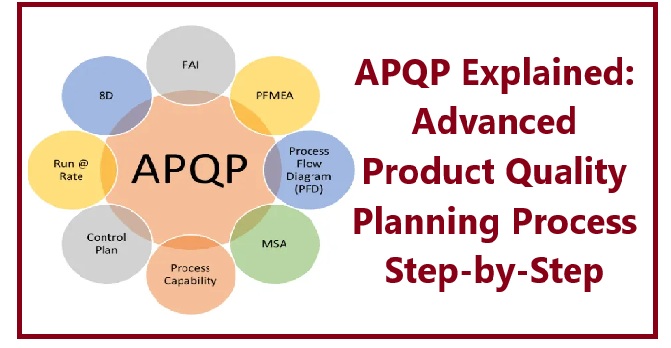
What is APQP? A short definition
Advanced Product Quality Planning (APQP) is a systematic approach used by manufacturing and automotive companies to ensure that a product is developed and launched with the highest level of quality from the very first day of production. It focuses on understanding customer needs, translating them into technical requirements, and building strong processes that can consistently deliver defect-free products.
APQP is not just a quality document or a formality. It is a complete planning methodology that brings together design, production, quality, purchasing, and suppliers on one common platform. Through structured phases, reviews, and risk analysis, APQP helps organizations prevent problems instead of reacting to them after mass production starts.
Originally developed by the Automotive Industry Action Group (AIAG), APQP is widely used across automotive, aerospace, and heavy engineering industries. It works closely with tools such as DFMEA, PFMEA, Control Plans, and PPAP to ensure that both the product design and manufacturing process are robust, capable, and customer-approved before full-scale production.
In simple words, APQP is the bridge between customer expectations and shop-floor reality. It ensures that what is promised in drawings and specifications is actually achieved in production with stable quality, controlled variation, and minimal risk. This makes APQP a cornerstone of modern quality management systems and a key requirement for successful product launch.
Advanced Product Quality Planning (APQP) is a structured framework for product development and launch that ensures customer requirements are translated into a product and process that consistently meet those requirements. APQP is not a single tool; it’s a project management and quality planning methodology made up of phases, deliverables and cross-functional checkpoints.
Industry origin: APQP was standardized by the Automotive Industry Action Group (AIAG) to align OEMs and suppliers on expectations for new product launches. It is often used together with PPAP (Production Part Approval Process), FMEA (Failure Mode & Effects Analysis), and Control Plans.
The APQP objectives
1. Translate Customer Requirements into Robust Product & Process Designs
The primary objective of APQP is to convert customer requirements into a clear product design and a capable production process. This ensures that what the customer expects is directly reflected in engineering specifications, tolerances, materials, performance criteria, and manufacturing systems.
2. Identify and Mitigate Technical & Manufacturing Risks Early
APQP helps teams recognize potential design failures, process instability, material risks, and capability issues before mass production begins. By addressing these risks early through tools like FMEA, DFM/A, SPC, and prototype builds, companies avoid costly changes after SOP (Start of Production).

3. Ensure Readiness of Manufacturing, Quality Systems & Suppliers
APQP ensures that manufacturing lines, quality controls, manpower training, resources, and suppliers are fully prepared for volume production. This includes validating equipment, checking process capability, verifying PFMEA & Control Plan, and performing trial runs to ensure smooth scale-up.
4. Provide Full Documented Evidence Through PPAP Submission
One of APQP’s key targets is to create a complete PPAP (Production Part Approval Process) package that proves the product and process meet all customer requirements. This documented evidence includes dimensional results, material tests, capability studies, control plan, PSW, and more.
5. Reduce Cost of Poor Quality & Improve Launch Predictability
By preventing defects at the planning stage, APQP significantly reduces rework, scrap, warranty claims, and line stoppages. It improves overall launch predictability, minimizes engineering changes during production, and increases customer confidence in the supplier’s capability.
APQP overview — the 5 core phases
Most AIAG/industry references break APQP into five core phases (sometimes shown as five major stages with sub activities):
- Plan and Define Program
- Product Design and Development (DFMEA, Design Verification)
- Process Design and Development (PFMEA, Process Flow, Control Plan)
- Product and Process Validation (Pilot runs, initial capability studies)
- Feedback, Assessment and Corrective Action (Sustaining & continuous improvement)
Below we unpackage each phase, step-by-step, with deliverables and practical tips.
Phase 1: Plan and Define Program — lay the foundation
Objective: Understand customer requirements (explicit and implicit), define scope, resources, and initial risk profile.
Key activities:
🚀 Checkout These Career-Boost Kits
- 📘 APQP Document 100+ – Click Here
- 📊 Production PPC 90+ Documents PPT – Click Here
- 📑 Six Sigma Format – Click Here
- 🎯 Dream Job Kit – Click Here
- 📂 60+ PPT Pack – Click Here
- 🗂️ HR Formats 100000+ – Click Here
- ✅ ISO 9001:2015 Toolkit – Click Here
- ⚙️ IATF (A–Z All Formats) – Click Here
- 📄 Resume Templates 700+– Click Here
- Customer requirement capture: Review customer specs, drawings, special characteristics, statutory/regulatory requirements.
- Voice of the Customer (VOC): Clarify functional requirements, tolerance limits, performance goals.
- Feasibility study & business case: Assess technical feasibility, capacity, sourcing, and cost targets.
- Project plan and timeline: Create milestone schedule (Gantt), responsibilities, and gate reviews.
- Team formation: Cross-functional team including engineering, purchasing, quality, manufacturing, and supplier representation.
- Initial risk assessment: High-level risk register; preliminary DFMEA triggers.
Typical deliverables:
- Program scope document
- Project charter (includes schedule, targets, team)
- Preliminary product requirements matrix
- Preliminary risk register / high-level FMEA inputs
Tip: Use a standardized Project Charter template with fields for target cost, target quality (PPM), and launch timing. This document becomes the anchor for subsequent APQP gates.
Phase 2: Product Design & Development — design for quality
Objective: Convert requirements into a validated design that meets functional and regulatory needs.
Key activities:
- Detailed design & CAD models—tolerance stackups, material selection, and DFMEA initiation.
- Design Failure Mode & Effects Analysis (DFMEA)—identify potential design failures, severity, occurrence and detection. Prioritize actions using Risk Priority Number (RPN) or updated risk scoring.
- Design reviews & verification plan: Define tests, analysis, and acceptance criteria. Consider environmental, durability, safety tests.
- Prototype builds / design iterations—lab samples, pre-series prototypes.
- Design validation & design verification: Compare test results to requirements; close DFMEA actions.
- Identification of Special Characteristics (SCs): Features that directly affect fit, function, safety; require tighter control.
Deliverables:
- DFMEA document with closed actions
- Design verification plan & reports (DV, DVP&R)
- Prototype reports and test data
- Updated drawings with revision levels and SC callouts
Best practice: Maintain a design traceability matrix linking each customer requirement to design outputs, verification methods, and acceptance criteria.
Phase 3: Process Design & Development — make it repeatable
Objective: Design a manufacturing process that can consistently produce to the design intent.
Key activities:
- Process flow chart — high-level flow mapping from raw material to packaged part.
- PFMEA (Process Failure Mode & Effects Analysis) — identify process risks, establish controls and actions.
- Machine & equipment selection — capability studies, layout planning, tooling and gage requirements.
- Control plan development — link process steps to control methods (in-process checks, gages, SPC).
- Work instructions & SOPs — detailed task steps, visual aids, torque values, and key process parameters.
- Measurement System Analysis (MSA) — Gage R&R studies to ensure measurement systems are adequate.
- Process capability studies (Cx, Cpk) — determine whether process variation meets tolerances in pilot stages.
Deliverables:
- PFMEA with corrective actions
- Control Plan (initial and updated)
- Process Flow Diagram (PFD) and Process Layout
- Work Instructions & SOPs
- MSA / Gage R&R reports
- Preliminary capability studies (Cp/Cpk)
Note: The Control Plan is the operational expression of PFMEA mitigations. It should be detailed enough for operators and auditors to follow.
Phase 4: Product & Process Validation — pilot & prove
Objective: Validate production readiness: pilot runs, capability validation, packaging & logistics.
Key activities:
- Pre-launch production runs (pilot builds, initial lot builds) — simulate volume conditions.
- Initial Process Capability (short-run and long-run) — measure Cpk for critical dimensions and special characteristics.
- Production Part Approval Process (PPAP) — gather documentation and evidence to submit to customer per agreed PPAP level (1–5). Typical PPAP content: PSW, dimensional results, material certifications, DFMEA/PFMEA, Control Plan, MSA, process capability results, and sample parts.
- Packaging and logistics validation — ensure packing prevents damage and meets shipping/handling constraints.
- Supplier readiness — verify sub-suppliers’ capacity, documentation, and PPAPs.
- Run at Rate (R@R) — demonstrate the production line’s ability to produce parts at required rates consistently.
Deliverables:
- PPAP submission package (per level required)
- Run at Rate / Pilot run reports
- Finalized Control Plan with parameter limits and monitoring frequency
- Approved packaging and labeling specs
Important: PPAP acceptance is a critical gate. Ensure traceability in all documents, and that special characteristics meet capability targets before submission.
Phase 5: Feedback, Assessment & Corrective Action — sustain and improve
Objective: Move from launch to sustained production with continuous improvement.
Key activities:
- Warranty and field feedback loop — capture real-world performance and feed into DFMEA/PFMEA.
- Corrective Action Process (CAPA) — close any launch issues with containment, root cause, and systemic actions.
- Control plan update — revise monitoring frequency, add SPC charts for trending, and update inspection criteria as required.
- Continuous Improvement (Kaizen) — reduce variation, improve throughput and cost through targeted initiatives.
- Periodic reviews — product health reviews, supplier performance reviews, and change management.
Deliverables:
- Updated DFMEA/PFMEA and Control Plan
- CAPA records and effectiveness verification
- Supplier corrective action records
- Ongoing SPC and quality metric dashboards
Tip: Make post-launch reviews formal (30/60/90 day reviews) to ensure lessons learned are institutionalized.
APQP tools & templates you should standardize
To make APQP repeatable, maintain a library of templates and tools:
- Project Charter / Gantt Chart
- Customer Requirements Matrix / CTQ tree
- DFMEA & PFMEA templates
- Control Plan template (linked to PFMEA)
- Process Flow Diagram template
- Work Instructions format (visual SOPs)
- MSA/Gage R&R templates
- Dimensional Inspection Sheet (using standard callouts)
- PPAP checklist & PSW template
- Run at Rate & pilot run report templates
- CAPA and RCA templates (5 Whys / Fishbone)
Creating company-wide templates reduces ambiguity and speeds up review cycles.
🚀 Checkout These Career-Boost Kits
- 📘 APQP Document 100+ – Click Here
- 📊 Production PPC 90+ Documents PPT – Click Here
- 📑 Six Sigma Format – Click Here
- 🎯 Dream Job Kit – Click Here
- 📂 60+ PPT Pack – Click Here
- 🗂️ HR Formats 100000+ – Click Here
- ✅ ISO 9001:2015 Toolkit – Click Here
- ⚙️ IATF (A–Z All Formats) – Click Here
- 📄 Resume Templates 700+– Click Here
Roles & responsibilities — who does what
A successful APQP rests on clear roles:
- Program Manager / APQP Lead: Coordinates cross-functional activities, schedule, and PPAP submission.
- Design Engineer: Product design, DFMEA, verification tests.
- Process Engineer: PFMEA, process flow, tooling, and capability studies.
- Quality Engineer: MSA, Control Plan, inspections, PPAP compilation.
- Production/Manufacturing Manager: Layout, manpower planning, run at rate.
- Purchasing / Supplier Quality Engineer: Supplier PPAPs and incoming material control.
- R&D/Test Labs: Prototype testing and validation.
Clear RACI matrices (Responsible/Accountable/Consulted/Informed) reduce last-minute confusion.
Common APQP Pitfalls and How to Avoid Them
Advanced Product Quality Planning (APQP) is designed to ensure flawless product launches, predictable quality, and robust processes. However, many organizations fall into common traps that delay programs, increase costs, and reduce customer confidence. Understanding these pitfalls—and knowing how to prevent them—helps teams execute APQP more effectively.
1. Starting APQP Too Late
Pitfall: Many teams begin APQP activities only after design freezes or tooling decisions. This reduces the opportunity to influence product design and prevents early risk identification.
How to Avoid:
- Start APQP at the concept stage, not after development.
- Integrate cross-functional reviews from day one.
- Use early-phase DFMEA and manufacturability checks to detect issues early.
2. Weak Cross-Functional Team Involvement
Pitfall: Only quality or engineering teams participate, leaving out manufacturing, purchasing, maintenance, and suppliers. This causes incomplete risk assessments and surprises during production.
How to Avoid:
- Build a strong CFT with representatives from all key functions.
- Ensure each team member owns deliverables (DFMEA, PFMEA, Control Plan, MSA, SPC).
- Schedule regular collaboration and joint reviews.
3. Poorly Executed FMEAs (DFMEA & PFMEA)
Pitfall: FMEAs are often copied from past projects, completed superficially, or done as documentation instead of a true risk-mitigation tool.
How to Avoid:
- Create fresh FMEAs aligned with the actual design and process.
- Focus on failure modes, root causes, and realistic RPN/Action Priority ratings.
- Review and update FMEAs throughout development and production.
4. Inadequate Process Validation (Trials, Capability, Run-at-Rate)
Pitfall: Skipping proper trials or capability studies leads to unstable processes during SOP.
How to Avoid:
- Conduct Pilot Builds, Run-at-Rate, and PPAP trial production properly.
- Validate equipment, tooling, gauges, and operator training.
- Ensure Cpk/Ppk ≥ customer requirements before approving production.
5. Insufficient Supplier Readiness Checks
Pitfall: Suppliers often are assumed to be ready without verifying their process capabilities and APQP progress.
How to Avoid:
- Perform supplier APQP tracking and readiness audits.
- Require supplier PPAP approval before integrating their parts.
- Monitor supplier capability (SPC, gauge studies, PFMEA quality).
6. Poor Document Control and Traceability
Pitfall: Missing, outdated, or inconsistent documents (DFMEA, PFMEA, Control Plan, MSA, SPC) lead to audit issues and confusion during launch.
How to Avoid:
- Use a centralized APQP documentation system.
- Maintain version control and ensure all teams access updated files.
- Prepare a complete PPAP package as the final output.
7. Not Following MPDS/Customer-Specific Requirements
Pitfall: Overlooking customer-specific requirements causes PPAP rejection and rework.
How to Avoid:
Review customer CSR at each APQP phase.
Align documents (QAP, Control Plan, FMEA) with customer formats.
Conduct internal audits before customer submission.
8. Over-Focus on Documentation Instead of Process Quality
Pitfall: Teams sometimes treat APQP as a paperwork exercise instead of improving real process robustness.
How to Avoid:
- Prioritize process mapping, process control, and defect prevention.
- Use tools like SPC, DOE, and root-cause analysis.
- Link every document to a real action or control method.
9. Ignoring Lessons Learned from Previous Projects
Pitfall: Without leveraging past project issues, teams repeat the same mistakes.
🚀 Checkout These Career-Boost Kits
- 📘 APQP Document 100+ – Click Here
- 📊 Production PPC 90+ Documents PPT – Click Here
- 📑 Six Sigma Format – Click Here
- 🎯 Dream Job Kit – Click Here
- 📂 60+ PPT Pack – Click Here
- 🗂️ HR Formats 100000+ – Click Here
- ✅ ISO 9001:2015 Toolkit – Click Here
- ⚙️ IATF (A–Z All Formats) – Click Here
- 📄 Resume Templates 700+– Click Here
How to Avoid:
- Create a “Lessons Learned” repository.
- Review it during design reviews, DFMEA/PFMEA workshops, and process planning.
- Make lessons learned mandatory inputs in new programs.
10. Rushing PPAP Submission
Pitfall: Organizations often attempt last-minute PPAP submissions leading to missing tests, invalid studies, and rejections.
How to Avoid:
- Begin PPAP preparation early (during APQP Phase 3 or 4).
- Follow a PPAP checklist.
- Conduct internal PPAP audits to ensure readiness.
APQP Timeline — Realistic Expectations for a Medium-Complexity Mechanical Component
A successful APQP (Advanced Product Quality Planning) project requires realistic scheduling, cross-functional collaboration, and careful integration of design and process activities. While timelines vary based on product complexity, customer requirements, and supplier capability, the following represents a practical and commonly used APQP timeline for medium-complexity mechanical or automotive components.
Phase 1: Plan and Define (2–4 Weeks)
This initial phase focuses on understanding customer requirements, gathering inputs, and defining the scope of the project.
Typical Activities:
- Customer requirement review
- Feasibility check
- Preliminary risk assessment
- Program charter creation
- Initial schedule & resource planning
- Early supplier involvement
Why 2–4 Weeks?
Most teams can finalize customer needs, basic feasibility, and planning within this period unless unique regulatory or technical complexities exist.
Phase 2: Product Design & Development (8–16 Weeks)
This phase is iterative, meaning multiple rounds of design reviews, simulations, and updates take place before design freeze.
Typical Activities:
- Design concepts & CAD development
- DFMEA creation and updates
- Prototype builds
- Material selection & design validation tests
- Design reviews (customer + internal)
- DFM/A (Design for Manufacturability & Assembly) feedback loops
Why 8–16 Weeks?
Mechanical components often require several cycles of virtual simulation, physical prototypes, and customer approvals. The duration depends on design maturity, testing needs, and customer responsiveness.
Phase 3: Process Design & Development (8–12 Weeks — Often Overlapping with Phase 2)
Process planning begins even before the design is frozen. Many organizetions run Phases 2 and 3 in parallel to avoid delays.
Typical Activities:
- Process Flow Diagram (PFD)
- PFMEA creation
- Control Plan drafting
- Tooling and fixture design
- Equipment purchase and development
- Work instructions preparation
- Layout planning & resource allocation
Why 8–12 Weeks?
Process design takes time due to tooling development, machine ordering, supplier coordination, and validation of manufacturing capability. Parallel execution helps meet aggressive launch schedules.
Phase 4: Product & Process Validation (4–8 Weeks)
This is the critical stage where both product and process capability are proven before mass production.
Typical Activities:
- Pilot build / pre-launch prodction
- MSA (Measurement System Analysis)
- SPC studies & capability improvement
- Run-at-Rate (RAR) / trial production
- PPAP documentation & submission
- Final customer approval
Why 4–8 Weeks?
This duration allows time for conducting studies, correcting issues, re-running capability checks, and completing all PPAP elements.
Phase 5: Production Launch, Feedback & Improvement (Ongoing)
Once PPAP is approved and SOP begins, APQP activities shift into continuous monitoring and improvement.
Typical Activities:
- Process monitoring using SPC
- Customer feedback review
- Corrective action implementation
- Lessons Learned documentation
- Continuous improvement
Why Ongoing?
APQP doesn’t end at launch. The sustain phase ensures the process remains capable and stable throughout the product life cycle.
Parallel Execution Is Essential
In real-world automotive & manufacturing environments, strict launch timelines require overlapping phases:
🚀 Checkout These Career-Boost Kits
- 📘 APQP Document 100+ – Click Here
- 📊 Production PPC 90+ Documents PPT – Click Here
- 📑 Six Sigma Format – Click Here
- 🎯 Dream Job Kit – Click Here
- 📂 60+ PPT Pack – Click Here
- 🗂️ HR Formats 100000+ – Click Here
- ✅ ISO 9001:2015 Toolkit – Click Here
- ⚙️ IATF (A–Z All Formats) – Click Here
- 📄 Resume Templates 700+– Click Here
- Design teams iterate while manufacturing teams start early tooling concepts.
- PFMEA and Control Plans evolve side-by-side with DFMEA.
- Validation activities often overlap with late design refinements.
This parallel structure reduces delays and ensures teams meet customer kickoff, trial, PPAP, and SOP milestones.
APQP & PPAP — how they connect
APQP is the planning framework and contains the deliverables (FMEAs, Control Plans, flow charts).
PPAP is the evidence package demonstrating readiness for production.
Think of APQP as the roadmap and PPAP as the final approval passport.
Practical example: APQP for an automotive stamped bracket (short case)
Phase 1: Receive customer print & CTQs — target cost, critical dimensional callouts identified. Project charter created.
Phase 2: Design team produces CAD & tolerance stack; DFMEA flags potential material forming cracks. Material selection and blanking die specs updated.
Phase 3: Process flow defined: blanking → bending → welding → surface finish. PFMEA identifies weld splatter and distortion as risks; control plan adds weld parameter checks, pre-heat controls. Gage R&R on weld length gage completed.
Phase 4: Pilot runs (200 pcs) completed. Dimensional capability Cpk >1.67 for SCs. PPAP package compiled and submitted (Level 3). Customer approves.
Phase 5: Post-launch weekly SPC trending; CAPA closed for minor burr issue with robust root cause and action.
Key Metrics to Track During APQP (Advanced Product Quality Planning)
Tracking the right metrics during APQP is essential for ensuring that quality tools are effective, risks are reduced, and the product is fully ready for launch. These metrics improve visibility, strengthen decision-making, and help management identify early warning signs before SOP (Start of Production).
Below are the most important APQP performance metrics, including what they mean and why they matter.
1. Design FMEA RPN Reduction Over Time
What It Measures:
The decrease in Risk Priority Number (or Action Priority improvements) for potential design failures as actions are implemented.
Why It Matters:
Indicates whether the design team is actively reducing high-risk failure modes.
Shows improvement in severity/occurrence/detection through corrective actions.
Reflects robustness of product design before tooling and prototype stages.
How to Track:
Weekly or bi-weekly DFMEA reviews
Trend chart from initial RPN/AP values to final values
Percentage of high-risk failure modes mitigated
2. PFMEA Action Closure Rate
What It Measures:
The percentage of identified PFMEA actions that are completed on schedule.
Why It Matters:
- Ensures manufacturing risk reduction happens before trials or run-at-rate.
- Prevents late surprises during PPAP validation.
- Shows discipline and cross-functional coordination between Quality, Production & Engineering.
How to Track:
- Number of open vs. closed PFMEA actions
- Action completion delay (in days)
- Closure rate target (e.g., >90% before Phase 4)
3. OTD (On-Time Delivery) of PPAP Submission
What It Measures:
The ability of the project team or supplier to submit PPAP documents as per customer’s deadline.
Why It Matters:
Directly impacts customer confidence and program launch timelines.
Late PPAP submission can delay SOP or trigger penalties.
Reflects planning quality, supplier readiness, and documentation control.
How to Track:
Actual submission date vs planned date
PPAP completeness score
Red/yellow/green status for PPAP deliverables
4. % of Process Characteristics with Cpk ≥ 1.67 (for Critical Features)
What It Measures:
Process capability of critical or special characteristics during validation trials or initial production.
Why It Matters:
Cpk ≥ 1.67 (or per CSR requirements) ensures process stability and low defect probability.
Directly connected to quality performance in early production.
Indicates readiness for PPAP approval and mass production.
How to Track:
Capability studies during pilot build
Number of characteristics meeting target capability
Improvement percentage after corrective actions
5. Supplier PPAP Approval Rate
What It Measures:
Percentage of supplier PPAPs approved on the first submission.
Why It Matters:
Suppliers contribute to the majority of quality risks in modern supply chains.
High rejection rates signal poor supplier APQP deployment.
Ensures upstream components are validated before assembly line trials.
How to Track:
First-time approval rate (FTAR)
Supplier PPAP resubmission cycles
Supplier scorecard trend month-over-month
6. Number of Nonconformances in First 30/60/90 Days After SOP
What It Measures:
Quality issues observed immediately after production launch.
Why It Matters:
🚀 Checkout These Career-Boost Kits
- 📘 APQP Document 100+ – Click Here
- 📊 Production PPC 90+ Documents PPT – Click Here
- 📑 Six Sigma Format – Click Here
- 🎯 Dream Job Kit – Click Here
- 📂 60+ PPT Pack – Click Here
- 🗂️ HR Formats 100000+ – Click Here
- ✅ ISO 9001:2015 Toolkit – Click Here
- ⚙️ IATF (A–Z All Formats) – Click Here
- 📄 Resume Templates 700+– Click Here
- Early failures indicate gaps in PFMEA, Control Plan, or operator training.
- Helps evaluate the real effectiveness of APQP activities.
- Reduces long-term cost of poor quality (COPQ) and customer complaints.
How to Track:
- Internal PPM or defect count during initial 30/60/90 days
- Customer complaints, returns, line rejections
- Trend reduction over time with corrective actions
APQP checklist (quick download-style list)
- Project Charter completed & signed
- VOC & CTQ matrix captured
- DFMEA completed & prioritized
- Design verification tests documented & passed
- Process flow diagram documented
- PFMEA completed & mitigations assigned
- Control Plan drafted and linked to PFMEA
- Work instructions & SOPs available
- MSA / Gage R&R completed for key gauges
- Pilot run & Run@Rate executed
- Capability studies (Cpk) for SCs documented
- PPAP package compiled & submitted per level
- Post-launch monitoring plan & CAPA process in place
Interview-ready: Top 10 APQP Questions & Model Answers
Q1. What is APQP and why is it used?
A: APQP (Advanced Product Quality Planning) is a structured framework to plan product and process development to ensure quality and launch readiness. It’s used to reduce risk, align teams, and provide documented evidence (PPAP) that production can meet customer requirements.
Q2. How many phases are in APQP?
A: Typically five: Plan & Define, Product Design, Process Design, Product & Process Validation, and Feedback/Corrective Action.
Q3. What is the difference between DFMEA and PFMEA?
A: DFMEA assesses design-related failure modes; PFMEA evaluates failures that can arise from manufacturing processes. Both are complementary and should be linked.
Q4. What is a Control Plan?
A: A Control Plan documents the process steps, inspection methods, parameters, frequency, and responsibility to monitor and control process performance to meet design requirements.
Q5. When should MSA be done in APQP?
A: MSA (Gauge R&R) should be done before capability studies and any critical measurement is used to accept or reject parts.
Q6. What is PPAP and how does it relate to APQP?
A: PPAP (Production Part Approval Process) is the submission package of evidence compiled from APQP activities and data proving production readiness. PPAP is a deliverable of APQP.
Q7. What is Run@Rate?
A: Run at Rate demonstrates the production line’s ability to produce parts at required cycle times and volumes consistently.
Q8. How do you prioritize FMEA actions?
A: Actions are prioritized by severity, occurrence, and detection, often using RPN or risk scoring. Highest risk items (high severity & frequency) get priority.
Q9. What are Special Characteristics?
A: Features that have direct impact on fit, form, function, safety or regulatory compliance. They require tighter control and capability demonstration.
Q10. What is a typical PPAP level and what does Level 3 include?
A: Common PPAP levels are 1–5. Level 3 typically includes the whole PPAP package with sample parts, dimensional results, material certifications, DFMEA/PFMEA, Control Plan, and capability data.
Conclusion — APQP as the backbone of reliable launches
APQP is the disciplined engine behind successful product launches. When organizations align product design, process development, and supplier readiness using APQP, they dramatically reduce surprises during launch and in the field. The discipline requires cross-functional collaboration, robust documentation and a continuous improvement mindset—yet the payoff is lowered warranty costs, faster launches and happier customers.
If you want a ready set of templates (Project Charter, DFMEA, PFMEA, Control Plan, PPAP checklist, MSA templates, and Run@Rate reports) to accelerate APQP in your plant or supply base, consider standardizing a document library and training teams with practical case studies.