
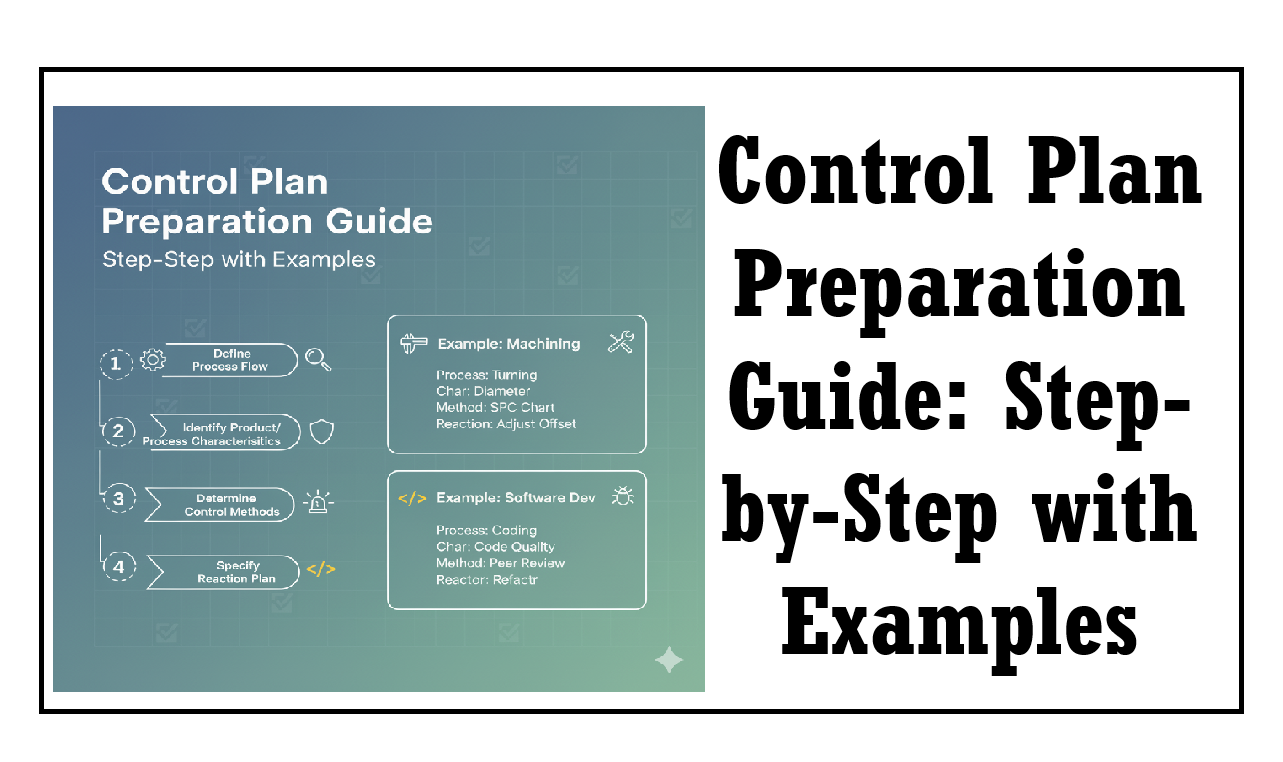
Control Plan Preparation Guide: Step-by-Step with Examples
🌟 Introduction: The Backbone of Manufacturing Quality
In every high-performing manufacturing organization, quality does not happen by chance — it’s the result of careful planning, standardized control, and disciplined execution. In many factories, quality problems are not caused by lack of inspection, but by lack of clear control. A missing reaction plan, an undefined frequency, or an untrained operator can turn a capable process into a defect generator. This is why the Control Plan is often called the “shop-floor constitution” of a manufacturing system.
That’s exactly where the Control Plan comes in.
A Control Plan is the master document that defines how to control a product or process to ensure it consistently meets customer requirements. It’s a central element of Advanced Product Quality Planning (APQP) and a mandatory deliverable in PPAP (Production Part Approval Process).
In this article, we’ll explore everything you need to know about Control Plans — their purpose, structure, and preparation steps — including templates, examples, and best practices for compliance with IATF 16949 and ISO 9001.
Who Should Use This Guide
- Quality Engineers & Inspectors
- Process & Manufacturing Engineers
- APQP / PPAP Coordinators
- IATF 16949 Internal Auditors
- Production Supervisors
- Diploma / BE Mechanical & Automobile Students
⚙️ What is a Control Plan?
A Control Plan is a documented description of the systems and processes required to control critical product and process characteristics.
It defines:
- What needs to be controlled
- How it will be controlled
- What measurement or inspection method will be used
- How often control will occur
- What to do if nonconformity is found
📘 Formal Definition (AIAG APQP Manual):
“A Control Plan is a written description of the systems used to minimize process and product variation by controlling key process and product characteristics.”
Simply put — the Control Plan ensures the process stays stable, capable, and within specifications.
🎯 Purpose of a Control Plan
- To ensure consistent product quality during mass production.
- To define control methods that detect or prevent nonconforming products.
- To maintain traceability and documentation for customer and audit compliance.
- To serve as a training and communication tool for operators and inspectors.
- To integrate lessons learned from FMEA, SPC, and process validation.
A Control Plan is the bridge between design intent and manufacturing reality.
🧩 Types of Control Plans
There are typically three types of Control Plans depending on the production stage:
| Type | Purpose | Timing |
|---|---|---|
| Prototype Control Plan | Used during prototype build to verify design feasibility. | During design validation |
| Pre-launch Control Plan | Used for pilot runs or limited production before mass manufacturing. | Before SOP (Start of Production) |
| Production Control Plan | Used for full-scale manufacturing to maintain quality consistency. | During regular production |
Each stage builds upon the previous, incorporating improvements and validated control methods.

🧱 Structure of a Control Plan
A standard Control Plan format (AIAG) includes the following sections:
| Section | Description |
|---|---|
| Part Number / Name | Identifies the component or assembly |
| Supplier / Plant | Location responsible for production |
| Control Plan Number | Unique identification for tracking |
| Date / Revision | Version control for document updates |
| Process Step / Operation | The process being controlled (e.g., Drilling, Welding) |
| Characteristic | The specific product or process parameter to monitor |
| Specification / Tolerance | Limits or acceptance criteria |
| Measurement Method | Inspection or test method used |
| Sample Size / Frequency | How often to check or measure |
| Control Method | How the characteristic is controlled (SPC, Poka-Yoke, etc.) |
| Reaction Plan | What to do if out-of-spec conditions occur |
🪜 Step-by-Step: How to Prepare a Control Plan
Let’s go through the Control Plan preparation process in detail:
Step 1: Define the Scope and Input Documents
Start by defining which process or part the Control Plan covers.
Typical input documents include:
- Process Flow Diagram (PFD)
- PFMEA (Process Failure Mode & Effects Analysis)
- Customer-specific requirements
- Inspection standards
- Work instructions
The Control Plan should directly correlate with your PFMEA — each high-risk failure mode must have a control listed.
Step 2: Identify Process Steps
List every manufacturing or assembly step in sequence as per the Process Flow Diagram.
Example for a machining part:
- Material Loading
- Turning
- Drilling
- Threading
- Cleaning
- Inspection
- Packing
Each of these steps will have its own controls in the Control Plan.
Step 3: Define Product and Process Characteristics
Identify:
- Product characteristics – measurable outputs (e.g., diameter, hardness, torque)
- Process characteristics – parameters affecting the process (e.g., machine speed, temperature, pressure)
Mark the special characteristics:
- 🔴 CC – Critical Characteristic (safety-related)
- 🔶 SC – Significant Characteristic (performance-related)
These symbols must match the drawing and FMEA symbols.
Step 4: Define Specifications and Tolerances
Specify the nominal value and tolerance limits for each characteristic.
🚀 Checkout These Career-Boost Kits
- 📘 APQP Document 100+ – Click Here
- 📊 Production PPC 90+ Documents PPT – Click Here
- 📑 Six Sigma Format – Click Here
- 🎯 Dream Job Kit – Click Here
- 📂 60+ PPT Pack – Click Here
- 🗂️ HR Formats 100000+ – Click Here
- ✅ ISO 9001:2015 Toolkit – Click Here
- ⚙️ IATF (A–Z All Formats) – Click Here
- 📄 Resume Templates 700+– Click Here
Example: Hole Diameter = 10.00 ± 0.05 mm
Torque = 25 ± 1 Nm
If the product drawing specifies the tolerance, reference it directly.
Step 5: Define Measurement or Test Method
Define how you’ll measure or inspect the characteristic:
- Vernier, micrometer, gauge, CMM, torque wrench, hardness tester, etc.
- Indicate inspection type: visual, attribute, or variable.
- Mention the reference standard (e.g., ISO 2768, ASTM, IS codes).
Step 6: Define Sample Size and Frequency
Determine how often measurements will be taken and how many samples:
- 100% inspection for critical features
- 1 sample per hour or shift for non-critical
- SPC monitoring for key characteristics
Example:
“Measure 2 samples per 100 parts using digital micrometer.”
Step 7: Define Control Methods
Define the preventive or monitoring methods used to maintain control, such as:
- SPC charts (X-bar, R, P, NP, C charts)
- Poka-Yoke devices
- Error-proofing sensors
- Go/No-Go gauges
- Automation feedback systems
Use statistical process control (SPC) wherever possible for variable data.
Step 8: Define Reaction Plan
This section is critical for operator response when an out-of-control condition occurs.
It should include:
- What to do (e.g., stop machine, segregate product)
- Who to inform (line leader, quality engineer)
- How to record and correct (use NCR or CAPA system)
Example:
“If torque < 23 Nm, stop operation, inform shift in-charge, recheck last 10 pieces, adjust tool.”
Step 9: Review and Cross-Check with PFMEA
Every Control Plan must be consistent with the PFMEA:
- All high RPN or Action Priority items must be covered with appropriate controls.
- The reaction plan should correspond to FMEA actions.
- Add any lessons learned or feedback from past customer complaints.
Step 10: Approve and Release the Control Plan
The final Control Plan should be reviewed by:
- Process Engineer
- Quality Engineer
- Manufacturing Manager
- Customer (if required in PPAP submission)
After approval, it becomes a controlled document and should be part of the shop floor reference folder.
🧩 Example: Control Plan Snippet
| Process Step | Characteristic | Spec / Tol. | Method | Freq. | Control | Reaction Plan |
|---|---|---|---|---|---|---|
| Drilling | Hole Diameter | 10.00 ± 0.05 mm | Digital Micrometer | 1/Hour | SPC (X-bar/R) | Stop machine, segregate last 10 pcs |
| Torque | Bolt Tightening Torque | 25 ± 1 Nm | Torque Wrench | 100% | Poka-Yoke + Visual | Inform QA, retighten and recheck |
| Cleaning | Surface Oil Level | NA | Visual | Each Batch | Visual Check | Reclean and re-inspect |
🧰 Tools Used with Control Plan
- FMEA – identifies what to control
- Process Flow Diagram – sequence reference
- SPC Charts – monitor variation
- Check Sheets – record inspection data
- Work Instructions – define operator methods
- Calibration Records – ensure accuracy
For engineers who want practical templates, filled examples, and shop-floor ready formats of Control Plans, PFMEA, SPC and APQP documents, InduPath.com provides structured industry-oriented learning material and downloadable formats aligned with IATF 16949 and ISO 9001. These resources help bridge the gap between textbook theory and real manufacturing implementation.
📘 Control Plan and PPAP Submission
Control Plan is a mandatory element of PPAP documentation under AIAG guidelines.
It supports elements like:
- FMEA (Element 4)
- MSA (Measurement System Analysis – Element 6)
- SPC (Element 9)
The Control Plan ensures that all process controls are defined and validated before PPAP submission.
🔄 Control Plan Revision and Update
The Control Plan must be a living document. Update it whenever:
- Design or process changes occur (ECR/ECN).
- New failure mode identified in FMEA.
- New customer requirement or complaint.
- Audit or CAPA feedback received.
Keep version control and document history clear for traceability.
🚀 Benefits of a Well-Structured Control Plan
- Ensures consistent process performance.
- Reduces process variability and rework.
- Increases customer satisfaction and audit readiness.
- Improves communication across departments.
- Enhances traceability and problem-solving.
❌ Common Mistakes in Control Plan Preparation
- Not linking Control Plan with FMEA or PFD.
- Using generic inspection methods instead of specific ones.
- Ignoring reaction plans or leaving them blank.
- Failing to review Control Plans after changes.
- Treating it as a one-time document, not a live system.
🧾 Control Plan Template (Excel Format)
A typical Control Plan template includes the following columns:
You can use Excel or specialized software like:
- AIAG Excel templates
- APIS IQ-FMEA
- ETQ Reliance
- Internal ERP or MES systems
For InduPath users, the downloadable Six Sigma Kit includes ready-to-use Control Plan Templates and SPC Sheets.
💡 Example from Automotive Industry
A Control Plan for a brake caliper assembly included:
- 12 process steps
- 45 product characteristics
- SPC for piston diameter and torque
- Error-proofing on critical assembly torque
After implementation, defect rate dropped from 1200 PPM to 150 PPM within 3 months — proving the power of proactive process control.
🧭 Link Between Control Plan and Quality Tools
| Tool | Purpose | Relationship with Control Plan |
|---|---|---|
| PFMEA | Identifies potential failures | Control Plan defines controls for high RPNs |
| SPC | Monitors process variation | Control Plan lists SPC characteristics |
| MSA | Validates measurement system | Ensures accuracy of inspection methods |
| Work Instructions | Defines operation | Derived from Control Plan control methods |
| Audit Checklist | Verifies compliance | Control Plan is used during process audit |
📈 Continuous Improvement with Control Plan
A Control Plan isn’t static.
It’s an evolving framework for Continuous Improvement (CI) — aligned with PDCA (Plan-Do-Check-Act) and Six Sigma DMAIC (Define-Measure-Analyze-Improve-Control) cycles.
Every revision brings new learning, better controls, and stronger quality culture.
Frequently Asked Questions (FAQ)
Q1. Is Control Plan mandatory for ISO 9001?
Yes. While not explicitly named, it is required under process control, monitoring, and operational planning clauses.
🚀 Checkout These Career-Boost Kits
- 📘 APQP Document 100+ – Click Here
- 📊 Production PPC 90+ Documents PPT – Click Here
- 📑 Six Sigma Format – Click Here
- 🎯 Dream Job Kit – Click Here
- 📂 60+ PPT Pack – Click Here
- 🗂️ HR Formats 100000+ – Click Here
- ✅ ISO 9001:2015 Toolkit – Click Here
- ⚙️ IATF (A–Z All Formats) – Click Here
- 📄 Resume Templates 700+– Click Here
Q2. Is Control Plan compulsory for PPAP?
Yes. It is a mandatory PPAP element under AIAG.
Q3. Who owns the Control Plan?
Process Engineering with approval from Quality and Production.
Q4. How often should Control Plan be updated?
Whenever PFMEA, process, tooling, material, or customer requirements change.
✅ Conclusion
The Control Plan is not just a form — it’s the heartbeat of process quality.
It captures every control method, inspection, and reaction needed to keep your manufacturing consistent and customer-focused.
A well-prepared Control Plan:
- Prevents quality issues before they happen.
- Builds audit and customer confidence.
- Supports continuous improvement.
“Control the process, and the product will take care of itself.”
By linking your Control Plan with FMEA, SPC, and real-time monitoring, you create a truly data-driven, proactive quality system — the hallmark of world-class manufacturing.