
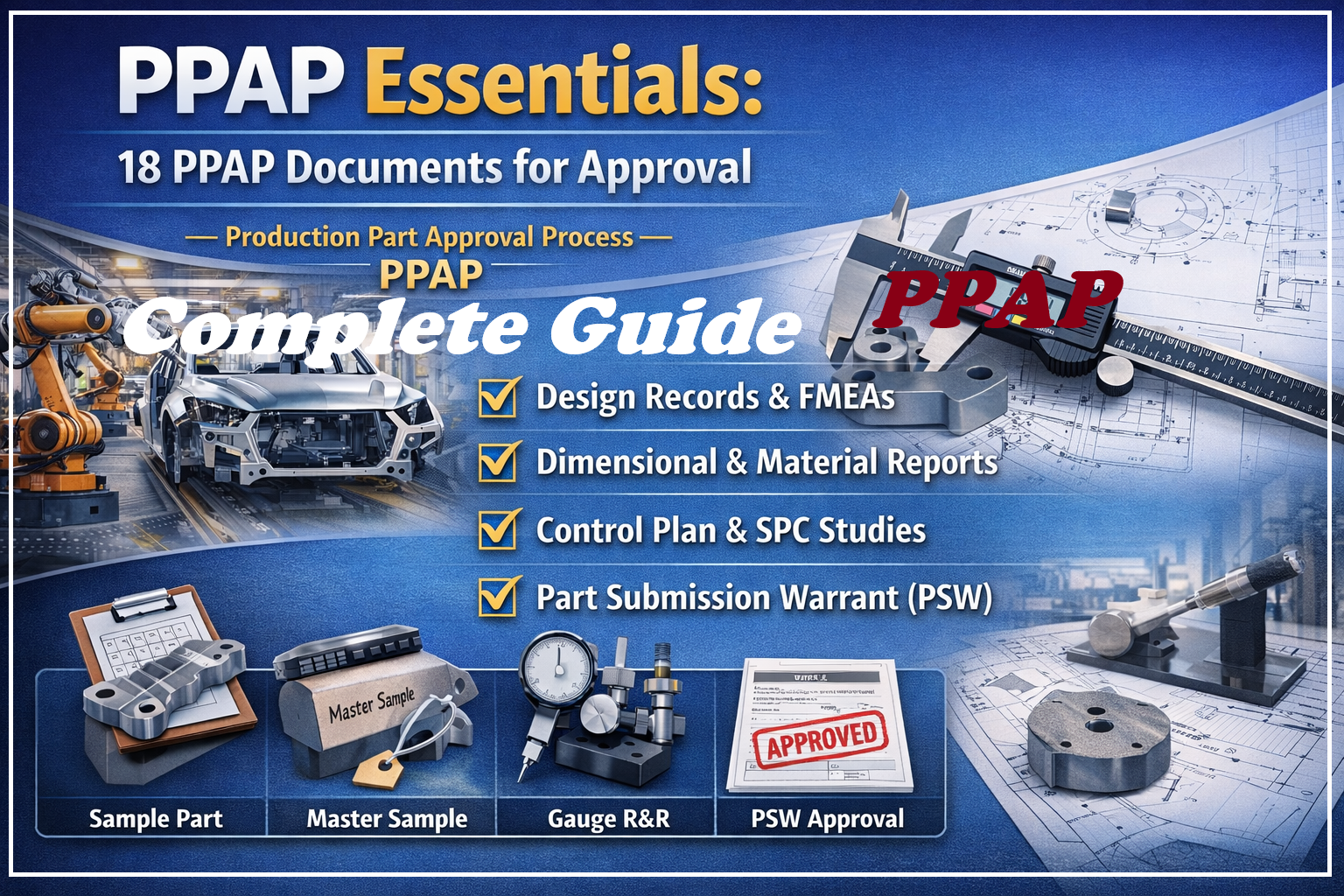
What is PPAP?
PPAP Documents , The Production Part Approval Process (PPAP) is not just a quality requirement—it is a confidence-building mechanism between customer and supplier.
At its core, PPAP answers one critical customer question:
“Can this supplier consistently produce this part, at the required volume, meeting all specifications, every single time?”
PPAP does not rely on promises.
It relies on evidence.
Evidence that:
- The design is fully understood
- Risks are systematically identified
- The manufacturing process is stable
- Controls are effective
- Variation is measurable and controlled
Only when data replaces assumptions, PPAP is complete.
- Why PPAP Exists: The Real Industry Problem It Solves
Before PPAP existed, automotive OEMs faced recurring issues:
- Good samples, bad mass production
- Last-minute firefighting during SOP
- High rejection rates after launch
- Frequent line stoppages
- Massive recall costs
The root cause was simple:
👉 Suppliers validated parts, not processes
PPAP was introduced to ensure:

- The process is validated, not just the part
- Problems are detected before SOP, not after
- Quality is built-in, not inspected later
PPAP transformed quality from reactive to preventive.
- PPAP Is Not Optional (Even When Customers Don’t Ask)
A common supplier misconception:
“Customer did not ask for PPAP, so we skipped it.”
In reality:
- If you are IATF 16949 certified, PPAP is mandatory
- Customer silence does not remove PPAP obligation
- During audits, missing PPAP = major non-conformity
Smart suppliers prepare PPAP proactively, even if submission is waived.
- PPAP vs APQP – How They Truly Connect
Many people confuse PPAP and APQP.
The truth:
- APQP = Planning & Development
- PPAP = Validation & Approval
APQP builds the road.
PPAP proves the road is safe to drive on.
PPAP is the final gate of APQP Phase 4:
👉 Product & Process Validation
Without APQP discipline, PPAP becomes paperwork.
Without PPAP, APQP remains theory.
🚀 Checkout These Career-Boost Kits
- 📘 APQP Document 100+ – Click Here
- 📊 Production PPC 90+ Documents PPT – Click Here
- 📑 Six Sigma Format – Click Here
- 🎯 Dream Job Kit – Click Here
- 📂 60+ PPT Pack – Click Here
- 🗂️ HR Formats 100000+ – Click Here
- ✅ ISO 9001:2015 Toolkit – Click Here
- ⚙️ IATF (A–Z All Formats) – Click Here
- 📄 Resume Templates 700+– Click Here
- PPAP in IATF 16949 – Where Auditors Look
PPAP is deeply embedded in IATF 16949, especially:
- Clause 8.3.4.4 – Product approval process
- Clause 8.5.1.1 – Control plan
- Clause 9.1.1.1 – Process capability
- Clause 8.4.2.3 – Supplier PPAP
Auditors don’t ask:
“Do you have PPAP?”
They ask:
“Show me evidence that your PPAP reflects current reality.”
Outdated PPAP = failed PPAP.
- Who Owns PPAP? (Hint: Not Just Quality)
PPAP ownership is cross-functional, but accountability is top management.
Typical Roles:
- Design / R&D – Design records, DFMEA
- Manufacturing Engineering – Process flow, PFMEA
- Quality – MSA, SPC, PSW, submission
- Production – Trial runs, capability
- Purchase / SQE – Sub-supplier PPAP
- Management – PSW authorization
If PPAP is treated as a quality document, it will fail.
PPAP must reflect actual shopfloor reality.
- When PPAP Is Required – Real-Life Triggers
PPAP is required whenever risk changes.
Mandatory PPAP Scenarios:
- New part introduction
- Drawing revision (even tolerance change)
- Tool change or refurbishment
- Process sequence change
- Change in raw material grade
- New sub-supplier
- Manufacturing location change
- Capacity expansion
- Repeated quality issues
- Temporary deviation approvals
Rule of thumb:
If the customer could ask “What changed?” → PPAP is required.
- PPAP From an OEM’s Eyes
OEMs don’t see PPAP as documents.
They see it as a risk report.
A strong PPAP tells the customer:
- Supplier understands risks
- Controls are proactive
- Process is predictable
- Future problems are unlikely
A weak PPAP tells the customer:
- Firefighting culture
- Poor discipline
- High future escalation risk
PPAP quality directly impacts:
- Supplier rating
- Future business
- Audit frequency
- Development opportunities
- PPAP Is a Competitive Advantage (Not a Burden)
Suppliers with mature PPAP systems:
- Get faster approvals
- Face fewer audits
- Have smoother launches
- Build long-term OEM trust
- Reduce internal rework & scrap
PPAP excellence is silent marketing.
OEMs remember suppliers who make their lives easy.
- What This Article Will Do for You
By the end of this 20,000-word guide, you will:
🚀 Checkout These Career-Boost Kits
- 📘 APQP Document 100+ – Click Here
- 📊 Production PPC 90+ Documents PPT – Click Here
- 📑 Six Sigma Format – Click Here
- 🎯 Dream Job Kit – Click Here
- 📂 60+ PPT Pack – Click Here
- 🗂️ HR Formats 100000+ – Click Here
- ✅ ISO 9001:2015 Toolkit – Click Here
- ⚙️ IATF (A–Z All Formats) – Click Here
- 📄 Resume Templates 700+– Click Here
- Understand every PPAP document deeply
- Know why each document exists
- Learn how OEMs actually evaluate PPAP
- Avoid common rejection mistakes
- Build PPAPs that get approved first time
PPAP Submission Levels : Meaning, Differences & OEM Expectations
- Why PPAP Submission Levels Exist
One of the most misunderstood aspects of PPAP is submission level selection.
Many suppliers assume:
“Level 3 is standard, so we always submit Level 3.”
This assumption leads to:
- Unnecessary documentation effort
- Delayed approvals
- Frustrated OEM quality teams
In reality, PPAP submission levels exist to balance risk, complexity, and confidence.
OEMs do not want more documents.
They want the right evidence for the right risk.
PPAP submission levels allow customers to:
- Scale documentation based on part criticality
- Reduce review load for low-risk parts
- Demand deeper validation for high-risk parts
Understanding submission levels correctly is critical for faster approvals.
- Overview of PPAP Submission Levels (At a Glance)
PPAP has five officially defined submission levels, as per AIAG.
| Level | What is Submitted | Typical Use |
| Level 1 | PSW only | Low-risk, repeat parts |
| Level 2 | PSW + limited documents | Minor changes |
| Level 3 | PSW + all 18 documents | New / critical parts |
| Level 4 | Customer-defined | Special cases |
| Level 5 | Full review at supplier site | High-risk / launch-critical |
👉 Level 3 is the most common, but not always required.
- Level 1 PPAP – PSW Only (When Confidence Already Exists)
What is Submitted?
- Part Submission Warrant (PSW) only
No additional documents are sent unless requested.
When Level 1 is Typically Used:
- Repeat parts with proven history
- No design or process change
- High supplier confidence
- Stable capability demonstrated earlier
OEM Perspective:
Level 1 does not mean “no PPAP”.
It means:
- Supplier must retain all PPAP documents internally
- OEM trusts the supplier’s system
- Documents can be demanded anytime during audit
Common Supplier Mistake:
❌ Not preparing PPAP at all
❌ Assuming Level 1 = zero documentation
This is a serious audit risk.
- Level 2 PPAP – PSW + Limited Supporting Data
What is Submitted?
- PSW
- Selected PPAP documents (as defined by customer)
Typical inclusions:
🚀 Checkout These Career-Boost Kits
- 📘 APQP Document 100+ – Click Here
- 📊 Production PPC 90+ Documents PPT – Click Here
- 📑 Six Sigma Format – Click Here
- 🎯 Dream Job Kit – Click Here
- 📂 60+ PPT Pack – Click Here
- 🗂️ HR Formats 100000+ – Click Here
- ✅ ISO 9001:2015 Toolkit – Click Here
- ⚙️ IATF (A–Z All Formats) – Click Here
- 📄 Resume Templates 700+– Click Here
- Control Plan
- Dimensional results
- Material test reports
- SPC summary
When Level 2 is Used:
- Minor engineering changes
- Supplier change with same process
- Low-risk components
- Cost reduction changes without functional impact
OEM Expectation:
OEMs expect:
- Focused evidence on changed elements
- No unnecessary bulk documentation
- Clear linkage between change and validation
Key Success Tip:
Always ask:
“Which PPAP elements does the customer expect for Level 2?”
Never assume.
- Level 3 PPAP – Full Submission (The Industry Benchmark)
What is Submitted?
✅ PSW + all 18 PPAP documents
This is the most widely used and expected PPAP level, especially for:
- New part development
- Safety or regulatory parts
- First-time suppliers
- New tooling or processes
Why OEMs Prefer Level 3
Level 3 gives OEMs:
- Complete visibility of risk
- Confidence in process robustness
- Baseline documentation for future changes
Supplier Reality:
Most OEM PPAP rejections happen at Level 3, not because:
- Data is missing
But because: - Documents are not aligned
- Data contradicts itself
- Risks are hidden, not addressed
Level 3 PPAP tests system maturity, not document quantity.
- Level 4 PPAP – Customer-Defined Submission
What Makes Level 4 Unique?
There is no standard format.
OEMs define:
- Which documents
- Depth of data
- Special formats
- Additional validation requirements
When Level 4 is Used:
- Complex assemblies
- New technology parts
- EV / battery components
- Export or regulatory-driven programs
Example:
🚀 Checkout These Career-Boost Kits
- 📘 APQP Document 100+ – Click Here
- 📊 Production PPC 90+ Documents PPT – Click Here
- 📑 Six Sigma Format – Click Here
- 🎯 Dream Job Kit – Click Here
- 📂 60+ PPT Pack – Click Here
- 🗂️ HR Formats 100000+ – Click Here
- ✅ ISO 9001:2015 Toolkit – Click Here
- ⚙️ IATF (A–Z All Formats) – Click Here
- 📄 Resume Templates 700+– Click Here
An OEM may ask:
- DFMEA + PFMEA
- Special characteristic control evidence
- Extended SPC data
- Reliability test reports
Supplier Strategy:
- Read customer communication carefully
- Do not apply “standard PPAP logic”
- Treat Level 4 as custom project approval
- Level 5 PPAP – On-Site Review (Maximum Scrutiny)
What Happens in Level 5?
Instead of sending documents:
- OEM visits supplier site
- Reviews PPAP on shopfloor
- Verifies actual implementation
Typical Level 5 Scenarios:
- New supplier onboarding
- Repeated quality failures
- High safety risk parts
- New manufacturing technology
OEM Focus Areas:
- PFMEA vs actual process
- Control plan execution
- Operator understanding
- Reaction plans in practice
- SPC running live
Critical Reality:
Level 5 PPAP is not about documents.
It is about process discipline.
A perfect file with poor shopfloor control will fail instantly.
- How OEMs Decide PPAP Submission Levels
OEMs evaluate risk, not supplier comfort.
Common Decision Factors:
- Part criticality (safety, regulatory)
- Complexity of design
- Manufacturing technology
- Past supplier performance
- Volume & launch importance
- Customer warranty exposure
Important Insight:
Even for the same part, PPAP level may change:
- Between suppliers
- Between plants
- Between programs
There is no universal default.
- Indian OEM Expectations (Practical Reality)
Based on industry practice:
Maruti Suzuki:
- Strong preference for Level 3
- High focus on SPC & capability
- Strict CSR compliance
Tata Motors:
- Level 3 for new parts
- Level 2 for minor ECNs
- Heavy PFMEA & control plan focus
Hyundai / Kia:
- Detailed dimensional & material evidence
- Special characteristic discipline
- Strong traceability expectations
Toyota (TMC / TKM):
- Fewer documents, deeper discipline
- Process thinking over paperwork
- Strong on-site validation
Understanding OEM culture is as important as standards.
🚀 Checkout These Career-Boost Kits
- 📘 APQP Document 100+ – Click Here
- 📊 Production PPC 90+ Documents PPT – Click Here
- 📑 Six Sigma Format – Click Here
- 🎯 Dream Job Kit – Click Here
- 📂 60+ PPT Pack – Click Here
- 🗂️ HR Formats 100000+ – Click Here
- ✅ ISO 9001:2015 Toolkit – Click Here
- ⚙️ IATF (A–Z All Formats) – Click Here
- 📄 Resume Templates 700+– Click Here
- Submission Level vs Approval Status (Often Confused)
Submission level ≠ approval result.
Approval statuses:
- Approved
- Approved with conditions
- Interim approval
- Rejected
You can submit:
- Level 3 PPAP → Get rejected
- Level 1 PPAP → Get approved
Approval depends on quality of evidence, not submission level.
- Why PPAP Level Alone Does Not Guarantee Approval
OEMs reject PPAP when:
- DFMEA and PFMEA are disconnected
- Control plan is theoretical
- SPC data is manipulated
- MSA is weak or invalid
- Dimensional results mismatch drawing
A smaller, honest PPAP is better than a large, weak one.
- Best Practices for Handling PPAP Submission Levels
✔ Always confirm submission level in writing
✔ Ask for customer-specific PPAP checklist
✔ Prepare full PPAP internally even for Level 1
✔ Maintain revision-controlled PPAP master file
✔ Train teams on “why”, not just “what”
PPAP success is predictable, not accidental.
- Transition to Next Step
Now that you understand:
- Why submission levels exist
- How OEMs think
- Where suppliers go wrong
It’s time to dive into the actual PPAP documents.
PPAP Documents: Design Records, Engineering Change Documents & Customer Engineering Approval
These first three PPAP elements form the foundation of the entire PPAP package.
If these are weak, no amount of PFMEA, SPC, or control plans can save the submission.
OEMs review these documents first because they answer one core question:
“Are we approving the correct part, at the correct revision, with full change control?”
- Why PPAP Always Starts With Design & Engineering Control
Before evaluating how a part is manufactured, the customer must be confident that:
- The design intent is clearly defined
- Any engineering changes are fully authorized
- Customer approval exists where required
Many PPAP rejections occur not due to quality issues, but due to:
- Wrong drawing revision
- Missing ECN reference
- Unapproved interim changes
This makes PPAP Documents 1–3 non-negotiable.
📄 PPAP DOCUMENT 1
Design Records
- What Are Design Records?
Design records are the official, controlled definition of the part to be manufactured.
They typically include:
- 2D engineering drawings
- 3D CAD models (where applicable)
- Specifications and notes
- Tolerances and material details
In PPAP terms, the design record represents:
🚀 Checkout These Career-Boost Kits
- 📘 APQP Document 100+ – Click Here
- 📊 Production PPC 90+ Documents PPT – Click Here
- 📑 Six Sigma Format – Click Here
- 🎯 Dream Job Kit – Click Here
- 📂 60+ PPT Pack – Click Here
- 🗂️ HR Formats 100000+ – Click Here
- ✅ ISO 9001:2015 Toolkit – Click Here
- ⚙️ IATF (A–Z All Formats) – Click Here
- 📄 Resume Templates 700+– Click Here
“This is exactly what the customer expects to receive.”
- Who Owns the Design Record?
Ownership depends on design responsibility.
Customer-Owned Design:
- OEM provides drawing
- Supplier manufactures “build-to-print”
- Supplier must not alter design
Supplier-Owned Design:
- Supplier designs part
- Customer approves design
- Higher PPAP responsibility
⚠️ Critical Rule:
PPAP must clearly state who owns design responsibility.
- Design Records in Practical Terms (What OEMs Check)
OEM reviewers look for:
- Latest drawing revision
- Correct part number
- Clear tolerances
- Special characteristics identified
- Consistency with PSW & dimensional results
Even a single mismatch can result in rejection.
- Common Design Record Mistakes (Seen in Audits)
❌ Old drawing revision attached
❌ Missing special characteristic symbols
❌ CAD model not aligned with 2D drawing
❌ Uncontrolled supplier-modified drawings
❌ Handwritten changes without ECN
These mistakes indicate poor change discipline.
- Best Practices for Design Records
✔ Maintain controlled drawing master list
✔ Use ballooned drawings for dimensional results
✔ Lock PPAP drawing revision at SOP
✔ Communicate clearly during ECNs
✔ Archive superseded revisions
Strong design control = strong PPAP start.
📄 PPAP DOCUMENT 2
Engineering Change Documents (ECN / ECR)
- Purpose of Engineering Change Documents
Engineering Change Documents exist to ensure:
- No unauthorized change reaches production
- All stakeholders understand the change
- Risks are evaluated before implementation
In PPAP, ECNs act as:
Proof that change is intentional, approved, and controlled
- When Are Engineering Change Documents Required?
ECNs are required for:
- Drawing revision change
- Tolerance modification
- Material grade change
- Process or tooling modification
- Supplier or location change
If something changed and no ECN exists, PPAP is automatically weak.
- Types of Engineering Change Documents
Common formats include:
- ECR (Engineering Change Request)
- ECN (Engineering Change Notice)
- Deviation approvals
- Temporary change approvals
OEMs expect:
- Reference number
- Change description
- Approval signatures
- Effective date
- Linking ECNs With PPAP Documents
A mature PPAP system ensures:
🚀 Checkout These Career-Boost Kits
- 📘 APQP Document 100+ – Click Here
- 📊 Production PPC 90+ Documents PPT – Click Here
- 📑 Six Sigma Format – Click Here
- 🎯 Dream Job Kit – Click Here
- 📂 60+ PPT Pack – Click Here
- 🗂️ HR Formats 100000+ – Click Here
- ✅ ISO 9001:2015 Toolkit – Click Here
- ⚙️ IATF (A–Z All Formats) – Click Here
- 📄 Resume Templates 700+– Click Here
- ECN number referenced in PSW
- ECN reflected in design record revision
- PFMEA updated for change
- Control plan revised accordingly
Isolated ECNs without PPAP linkage are a red flag.
- Common Engineering Change Mistakes
❌ Verbal approvals without records
❌ Temporary deviation used permanently
❌ ECN approved after PPAP submission
❌ No PFMEA or control plan update
OEMs treat such cases as process breakdown.
📄 PPAP DOCUMENT 3
Customer Engineering Approval
- What Is Customer Engineering Approval?
Customer Engineering Approval is formal confirmation from the customer that:
- The part or process is acceptable for use
- Approval is given for specific conditions or duration
- Supplier is authorized to proceed
This document is mandatory only when required by customer.
- Typical Scenarios Requiring Customer Engineering Approval
- Interim PPAP approvals
- Deviation approvals
- Prototype-to-production transitions
- Trial or pilot builds
- Special process approvals
Without documented customer approval, production supply is unauthorized.
- Interim vs Full Approval
Interim Approval:
- Time-bound
- Volume-limited
- Risk-controlled
- Requires follow-up PPAP
Full Approval:
- No restrictions
- Serial production allowed
- Baseline PPAP established
Failure to convert interim approval into full approval is a serious compliance risk.
- What OEMs Look for in Customer Engineering Approval
OEMs verify:
- Approval scope
- Part number & revision
- Validity period
- Conditions or limitations
- Authorized signatory
Emails without authority or unclear scope are not acceptable.
- Common Supplier Errors
❌ Supplying parts beyond interim approval limits
❌ Missing approval documentation
❌ Assuming silence means approval
❌ Mixing prototype and production approvals
These mistakes often lead to retroactive PPAP rejection.
- How Documents 1–3 Set the Tone for PPAP Success
If:
- Design is clear
- Changes are controlled
- Approval is documented
Then:
- PFMEA becomes meaningful
- Control plans align naturally
- SPC data makes sense
Weak start = cascading failure.
- Transition to Next Step
Now that the design and change foundation is solid, it’s time to move into risk analysis and process definition.
PPAP Documents 4–6: DFMEA, Process Flow Diagram & PFMEA
This step is the heart of PPAP.
🚀 Checkout These Career-Boost Kits
- 📘 APQP Document 100+ – Click Here
- 📊 Production PPC 90+ Documents PPT – Click Here
- 📑 Six Sigma Format – Click Here
- 🎯 Dream Job Kit – Click Here
- 📂 60+ PPT Pack – Click Here
- 🗂️ HR Formats 100000+ – Click Here
- ✅ ISO 9001:2015 Toolkit – Click Here
- ⚙️ IATF (A–Z All Formats) – Click Here
- 📄 Resume Templates 700+– Click Here
OEMs may tolerate minor formatting issues in other documents, but they never compromise on risk analysis.
Documents 4–6 collectively answer one brutal customer question:
“What can go wrong, where can it go wrong, and how have you prevented it?”
Most PPAP rejections globally happen right here.
- Why Risk Analysis Is the Core of PPAP
PPAP is not a documentation exercise.
It is a risk elimination exercise.
OEMs know:
- No process is perfect
- Variation is inevitable
- Human error will occur
What they want to see is:
- Risks are identified early
- Severity is understood
- Controls are deliberate, not accidental
Documents 4–6 create a logical risk chain:
DFMEA → Process Flow → PFMEA → Control Plan
If this chain is broken, PPAP collapses.
📄 PPAP DOCUMENT 4
Design Failure Mode and Effects Analysis (DFMEA)
- What Is DFMEA (In Practical Terms)?
DFMEA is a structured way to predict how a design might fail in real life.
It does not ask:
“Is the design good?”
It asks:
“How could this design fail once it reaches the customer?”
DFMEA evaluates:
- Functions
- Failure modes
- Effects on customer
- Causes
- Design controls
- When DFMEA Is Mandatory
DFMEA is required when:
- Supplier has design responsibility
- Part function impacts safety or performance
- New design or material is introduced
- Significant design change occurs
If supplier is build-to-print, DFMEA may not be required — but OEM confirmation is mandatory.
- What OEMs Expect in a Strong DFMEA
OEMs look beyond the table.
They expect:
🚀 Checkout These Career-Boost Kits
- 📘 APQP Document 100+ – Click Here
- 📊 Production PPC 90+ Documents PPT – Click Here
- 📑 Six Sigma Format – Click Here
- 🎯 Dream Job Kit – Click Here
- 📂 60+ PPT Pack – Click Here
- 🗂️ HR Formats 100000+ – Click Here
- ✅ ISO 9001:2015 Toolkit – Click Here
- ⚙️ IATF (A–Z All Formats) – Click Here
- 📄 Resume Templates 700+– Click Here
- Clear functional thinking
- Customer-focused failure effects
- Realistic causes (not generic)
- Logical severity ranking
- Action-oriented prevention controls
A copied DFMEA is instantly visible to reviewers.
- DFMEA vs PFMEA (Critical Difference)
| DFMEA | PFMEA |
| Design focused | Process focused |
| What can fail in function | What can fail in manufacturing |
| Customer usage impact | Production risk impact |
| Engineering responsibility | Manufacturing responsibility |
Confusing the two is a major PPAP error.
- Common DFMEA Mistakes Seen in Audits
❌ Generic failure modes
❌ No linkage to special characteristics
❌ Severity artificially lowered
❌ Actions not closed before PPAP
❌ DFMEA not updated after ECN
OEMs interpret this as poor design maturity.
- DFMEA Best Practices
✔ Start DFMEA during concept phase
✔ Involve cross-functional team
✔ Link DFMEA to drawings
✔ Flag special characteristics early
✔ Keep DFMEA alive post-SOP
DFMEA is a living risk document, not a formality.
📄 PPAP DOCUMENT 5
Process Flow Diagram
- Why Process Flow Diagram Is Non-Negotiable
The Process Flow Diagram shows:
“How exactly this part is made, step by step.”
It is the bridge between design and manufacturing reality.
Without it:
- PFMEA becomes imaginary
- Control plan becomes theoretical
- What a Good Process Flow Diagram Includes
A robust process flow shows:
- Incoming material receipt
- Each manufacturing operation
- Inspection and testing points
- Rework loops
- Packing and dispatch
It must reflect actual shopfloor flow, not an ideal one.
- Process Flow Diagram vs Routing Sheet
Many suppliers confuse these.
- Routing sheet = cost & planning tool
- Process flow diagram = risk analysis foundation
OEMs expect:
- Visual clarity
- Logical sequence
- Clear interfaces
- Common Process Flow Mistakes
❌ Missing inspection steps
❌ Rework not shown
❌ Offline operations ignored
❌ Flow does not match PFMEA
❌ Old flow not updated after changes
These gaps are immediately flagged.
- Best Practices for Process Flow Diagrams
✔ Walk the shopfloor while creating it
✔ Involve operators and supervisors
✔ Keep it simple but complete
✔ Update after every process change
✔ Use as PFMEA reference
Process flow must tell the true story.
📄 PPAP DOCUMENT 6
🚀 Checkout These Career-Boost Kits
- 📘 APQP Document 100+ – Click Here
- 📊 Production PPC 90+ Documents PPT – Click Here
- 📑 Six Sigma Format – Click Here
- 🎯 Dream Job Kit – Click Here
- 📂 60+ PPT Pack – Click Here
- 🗂️ HR Formats 100000+ – Click Here
- ✅ ISO 9001:2015 Toolkit – Click Here
- ⚙️ IATF (A–Z All Formats) – Click Here
- 📄 Resume Templates 700+– Click Here
Process Failure Mode and Effects Analysis (PFMEA)
- What PFMEA Really Is (Not What People Think)
PFMEA is not:
❌ A copied table
❌ A one-time document
❌ A quality form
PFMEA is:
A structured method to anticipate manufacturing failures before they reach the customer.
It evaluates:
- Each process step
- Possible failure modes
- Effects
- Causes
- Controls
- Risk priority
- How PFMEA Should Be Built
Correct sequence:
- Start from Process Flow Diagram
- Analyze each operation
- Identify realistic failure modes
- Assign severity, occurrence, detection
- Define strong preventive controls
- Close actions before PPAP
If PFMEA is built before process flow, it is wrong.
- Special Characteristics in PFMEA
OEMs pay extreme attention here.
Special characteristics must:
- Originate from DFMEA or drawing
- Be clearly marked
- Have enhanced controls
- Appear in control plan
Missing this linkage is a common rejection reason.
- PFMEA Scoring: What OEMs Really Care About
OEMs don’t focus only on RPN.
They look for:
- High severity items (S ≥ 9)
- Weak detection controls
- Over-reliance on inspection
- Lack of mistake-proofing
Lowering numbers without actions is not acceptable.
- Common PFMEA Failures
❌ Same PFMEA used for different parts
❌ Generic causes like “operator error”
❌ No linkage to control plan
❌ Actions not closed before SOP
❌ PFMEA not updated after issues
This signals immature process thinking.
- How Documents 4–6 Work Together
Correct PPAP logic:
- DFMEA defines what must not fail
- Process Flow defines how part is made
- PFMEA defines how process could fail
- Control Plan defines how failures are prevented
Break this chain → PPAP weakens.
- OEM View: What a Good Risk Chain Looks Like
OEM reviewers want to see:
- Logical flow across documents
- Same language used consistently
- Risks translated into controls
- Evidence of learning from past issues
This is how trust is built.
- Transition to Next Step
Now that risks are identified and mapped, the next step is to define how those risks are controlled on the shopfloor.
🚀 Checkout These Career-Boost Kits
- 📘 APQP Document 100+ – Click Here
- 📊 Production PPC 90+ Documents PPT – Click Here
- 📑 Six Sigma Format – Click Here
- 🎯 Dream Job Kit – Click Here
- 📂 60+ PPT Pack – Click Here
- 🗂️ HR Formats 100000+ – Click Here
- ✅ ISO 9001:2015 Toolkit – Click Here
- ⚙️ IATF (A–Z All Formats) – Click Here
- 📄 Resume Templates 700+– Click Here
PPAP Document 7: Control Plan – The Shopfloor Execution Blueprint
If PPAP had a single most important document, the Control Plan would be it.
OEMs often say privately:
“If the control plan is weak, everything else is just paperwork.”
Because the Control Plan answers one decisive question:
“How will you ensure that today, tomorrow, and six months later, the same good part is produced every time?”
- Why the Control Plan Is the Backbone of PPAP
DFMEA predicts risk.
PFMEA analyzes manufacturing risk.
But only the Control Plan ensures risk is actually controlled on the shopfloor.
It converts:
- Risk thinking → Action
- Theory → Practice
- Intent → Discipline
A Control Plan is not written for auditors.
It is written for operators, supervisors, and quality engineers.
- What Exactly Is a Control Plan?
A Control Plan is a structured description of controls applied at each process step to:
- Prevent defects
- Detect variation early
- Define reaction plans
- Protect the customer
It defines:
- What to control
- How to control
- How often to control
- Who controls
- What to do when control fails
- Types of Control Plans in PPAP
PPAP recognizes three types of control plans, but only two are commonly used.
1️⃣ Prototype Control Plan
- Used during prototype phase
- Focus on learning
- Temporary controls allowed
2️⃣ Pre-Launch Control Plan
- Used during pilot / trial runs
- Enhanced inspection and monitoring
- Short-term risk containment
3️⃣ Production Control Plan
- Used for serial production
- Stable, mistake-proofed controls
- Long-term discipline
For PPAP, Pre-Launch and Production Control Plans are critical.
- Pre-Launch Control Plan: Why OEMs Care Deeply
The Pre-Launch Control Plan exists because:
- New processes are unstable
- Operators are learning
- Tooling is being fine-tuned
OEMs expect:
- Higher inspection frequency
- Additional checks
- Temporary controls
- Clear transition plan to production control
Skipping pre-launch discipline is a classic PPAP rejection reason.
- Production Control Plan: The Final Commitment
The Production Control Plan represents a promise:
🚀 Checkout These Career-Boost Kits
- 📘 APQP Document 100+ – Click Here
- 📊 Production PPC 90+ Documents PPT – Click Here
- 📑 Six Sigma Format – Click Here
- 🎯 Dream Job Kit – Click Here
- 📂 60+ PPT Pack – Click Here
- 🗂️ HR Formats 100000+ – Click Here
- ✅ ISO 9001:2015 Toolkit – Click Here
- ⚙️ IATF (A–Z All Formats) – Click Here
- 📄 Resume Templates 700+– Click Here
“This is how we will control this process for years.”
OEMs evaluate:
- Sustainability of controls
- Dependence on human inspection
- Presence of poka-yoke
- Realistic reaction plans
A production control plan based purely on inspection is considered weak.
- Mandatory Linkage: Control Plan ↔ PFMEA ↔ Process Flow
This linkage is non-negotiable.
OEMs verify:
- Every PFMEA high-risk item appears in control plan
- Every special characteristic is controlled
- Control plan sequence matches process flow
If one document changes, all three must be updated.
- Key Columns of a Control Plan (Explained Practically)
Let’s break this down in real shopfloor language.
Process Step
- Must match process flow
- Clear operation name
- No generic wording
Product / Process Characteristics
- Dimensions, material, performance
- Special characteristics clearly marked
Control Method
- SPC, poka-yoke, go/no-go gauge
- Visual checks are weak if used alone
Measurement Technique
- Gauge name, CMM, fixture
- Must align with MSA
Sample Size & Frequency
- Logical and risk-based
- “100% inspection” must be justified
Reaction Plan
- Immediate action
- Containment
- Root cause
- Documentation
OEMs read reaction plans very carefully.
- Reaction Plan: Where Most Control Plans Fail
A weak reaction plan looks like:
“Inform quality engineer.”
OEMs expect:
- Stop production criteria
- Segregation method
- Customer notification logic
- Root cause responsibility
- Prevent recurrence steps
A reaction plan that doesn’t protect the customer is unacceptable.
- Special Characteristics in the Control Plan
Special characteristics are:
- Safety-related
- Regulatory-related
- Function-critical
OEMs expect:
🚀 Checkout These Career-Boost Kits
- 📘 APQP Document 100+ – Click Here
- 📊 Production PPC 90+ Documents PPT – Click Here
- 📑 Six Sigma Format – Click Here
- 🎯 Dream Job Kit – Click Here
- 📂 60+ PPT Pack – Click Here
- 🗂️ HR Formats 100000+ – Click Here
- ✅ ISO 9001:2015 Toolkit – Click Here
- ⚙️ IATF (A–Z All Formats) – Click Here
- 📄 Resume Templates 700+– Click Here
- Enhanced controls
- SPC where applicable
- Error-proofing preference
- Clear escalation paths
If special characteristics are treated like normal dimensions, PPAP fails.
- Control Plan vs Work Instructions (Often Confused)
- Control Plan = What must be controlled
- Work Instructions = How operators perform the task
OEMs expect:
- Control plan references work instructions
- Operators understand both
- Documents are consistent
Control plans that don’t reach the shopfloor are dead documents.
- Common Control Plan Mistakes (Real Audit Findings)
❌ Generic templates reused
❌ No link to PFMEA
❌ Unrealistic inspection frequency
❌ Weak or missing reaction plans
❌ Control plan not followed on shopfloor
Auditors don’t just read — they verify execution.
- How OEMs Evaluate Control Plan Effectiveness
OEMs check:
- Does SPC actually run?
- Are records maintained?
- Do operators know reaction steps?
- Are controls preventive or detective?
- Are past issues reflected?
A perfect document with poor execution fails instantly.
- Control Plan as a Living Document
A strong organization:
- Updates control plan after issues
- Reviews it during audits
- Trains operators on changes
- Uses it for continuous improvement
A static control plan signals immaturity.
- Digital vs Manual Control Plans (Modern Reality)
Many OEMs now accept:
- Digital SPC
- MES-linked controls
- Automated data capture
But expectations remain:
- Data integrity
- Traceability
- Accessibility during audits
Technology does not replace discipline.
- Control Plan Ownership & Accountability
Ownership typically lies with:
- Manufacturing engineering
- Quality engineering
Accountability lies with:
- Plant management
Unsigned or unauthorized control plans are invalid.
- Why Control Plan Quality Determines PPAP Speed
Strong control plans:
- Reduce OEM questions
- Minimize on-site reviews
- Build confidence
- Speed up approval
Weak control plans:
- Trigger audits
- Delay SOP
- Increase scrutiny
OEMs trust execution, not explanations.
- Transition to Next Step
Now that controls are defined, the next question becomes:
“Are our measurement systems reliable, and do results actually meet requirements?”
🚀 Checkout These Career-Boost Kits
- 📘 APQP Document 100+ – Click Here
- 📊 Production PPC 90+ Documents PPT – Click Here
- 📑 Six Sigma Format – Click Here
- 🎯 Dream Job Kit – Click Here
- 📂 60+ PPT Pack – Click Here
- 🗂️ HR Formats 100000+ – Click Here
- ✅ ISO 9001:2015 Toolkit – Click Here
- ⚙️ IATF (A–Z All Formats) – Click Here
- 📄 Resume Templates 700+– Click Here
That brings us to measurement, dimensional validation, and material testing.
PPAP Documents 8–10: Measurement System Analysis (MSA), Dimensional Results & Material / Performance Test Results
At this stage of PPAP, OEMs shift their mindset.
Up to now, the question was:
“Have you identified and controlled risks?”
Now the question becomes:
“Can we trust the data you are showing us?”
Documents 8–10 exist to prove data credibility.
If measurement systems are weak, all previous PPAP documents lose value.
- Why OEMs Scrutinize Measurement & Test Evidence
OEMs have learned through experience:
- Bad decisions come from bad data
- False acceptance is more dangerous than false rejection
- Unreliable gauges hide real problems
That’s why:
- MSA failures often lead to PPAP rejection
- Dimensional mismatches are taken very seriously
- Material data must be traceable and accredited
Trust in measurement is non-negotiable.
📄 PPAP DOCUMENT 8
Measurement System Analysis (MSA)
- What MSA Really Proves (Beyond Formulas)
MSA does not prove:
❌ Operator skill
❌ Part quality
MSA proves:
That the measurement system itself is capable of distinguishing good parts from bad parts.
Without MSA:
- SPC data is meaningless
- Dimensional reports are unreliable
- Decisions are guesswork
- Types of MSA Required in PPAP
OEMs expect MSA based on the type of measurement.
Common MSA Studies:
- Gage Repeatability & Reproducibility (GR&R)
- Bias
- Linearity
- Stability
Not every gauge needs all studies, but GR&R is almost always mandatory.
🚀 Checkout These Career-Boost Kits
- 📘 APQP Document 100+ – Click Here
- 📊 Production PPC 90+ Documents PPT – Click Here
- 📑 Six Sigma Format – Click Here
- 🎯 Dream Job Kit – Click Here
- 📂 60+ PPT Pack – Click Here
- 🗂️ HR Formats 100000+ – Click Here
- ✅ ISO 9001:2015 Toolkit – Click Here
- ⚙️ IATF (A–Z All Formats) – Click Here
- 📄 Resume Templates 700+– Click Here
- GR&R: The Most Critical Study
GR&R evaluates:
- Variation from the gauge
- Variation from operators
- Combined measurement error
OEM Acceptance Criteria (Typical):
- ≤10% → Excellent
- 10–30% → Acceptable with justification
- 30% → Unacceptable
Submitting GR&R >30% without action is a guaranteed rejection.
- Common GR&R Mistakes in PPAP
❌ Using too few parts
❌ Non-representative samples
❌ Wrong study method (average & range vs ANOVA)
❌ Running GR&R on attribute gauges incorrectly
❌ Using old or expired studies
OEMs verify study validity, not just results.
- Attribute MSA: Frequently Mishandled
Attribute gauges (visual, go/no-go) are often:
- Underestimated
- Poorly validated
OEMs expect:
- Attribute agreement analysis
- Clear accept/reject criteria
- Trained operators
A “visual inspection” without attribute MSA is not acceptable.
- Best Practices for Strong MSA Submissions
✔ Conduct MSA during pre-launch
✔ Use actual production conditions
✔ Train operators before study
✔ Re-do MSA after gauge changes
✔ Link MSA results to control plan
MSA is a foundation, not a checkbox.
📄 PPAP DOCUMENT 9
Dimensional Results
- Purpose of Dimensional Results in PPAP
Dimensional results prove:
That parts produced during the PPAP run meet all drawing requirements.
This is not routine inspection.
This is full layout verification.
- What OEMs Expect in Dimensional Results
OEMs typically expect:
- All drawing dimensions measured
- Ballooned drawing reference
- Sample size as per PPAP requirement
- Actual measured values
- Clear pass/fail status
Missing even one dimension can lead to rejection.
- Sample Size for Dimensional Results
Common expectations:
- 5 parts minimum (typical)
- All cavities for multi-cavity tools
- All variations represented
Using cherry-picked samples is unacceptable.
- Ballooned Drawings: Non-Negotiable
Ballooned drawings ensure:
🚀 Checkout These Career-Boost Kits
- 📘 APQP Document 100+ – Click Here
- 📊 Production PPC 90+ Documents PPT – Click Here
- 📑 Six Sigma Format – Click Here
- 🎯 Dream Job Kit – Click Here
- 📂 60+ PPT Pack – Click Here
- 🗂️ HR Formats 100000+ – Click Here
- ✅ ISO 9001:2015 Toolkit – Click Here
- ⚙️ IATF (A–Z All Formats) – Click Here
- 📄 Resume Templates 700+– Click Here
- Traceability
- Clarity
- No missed features
OEMs immediately reject:
❌ Non-ballooned reports
❌ Unclear references
❌ Dimension numbers mismatched
- Common Dimensional Result Errors
❌ Units mismatch (mm/inch)
❌ Measurement method not defined
❌ Missing special characteristics
❌ Results rounded to hide variation
❌ Manual edits without traceability
OEMs assume data manipulation when clarity is poor.
- Best Practices for Dimensional Reporting
✔ Use CMM where appropriate
✔ Show actual values, not just OK/NG
✔ Clearly mark special characteristics
✔ Align with control plan methods
✔ Archive raw data
Dimensional honesty builds trust.
📄 PPAP DOCUMENT 10
Material & Performance Test Results
- Purpose of Material & Performance Testing
These tests confirm:
- Correct material usage
- Compliance with specifications
- Functional performance under load
OEMs treat material deviations as high-risk issues.
- Types of Material Tests Commonly Required
- Chemical composition
- Mechanical properties
- Heat treatment verification
- Coating / plating thickness
- Hardness tests
Performance tests may include:
- Fatigue
- Pressure
- Torque
- Durability
- Accredited Laboratories: Why They Matter
OEMs expect:
- ISO/IEC 17025 accredited labs
- Scope covering test performed
- Traceable calibration
Unaccredited lab reports are frequently rejected.
- Material Test Traceability
OEMs check:
- Batch / heat number
- Supplier certificate linkage
- Test date vs PPAP run
- Part identification
Mismatch between material and parts tested is a critical finding.
- Common Material Test Mistakes
❌ Old test certificates reused
❌ Tests not matching drawing specs
❌ Missing accreditation details
❌ No linkage to incoming inspection
❌ Over-reliance on supplier CoC
OEMs expect verification, not blind trust.
- Integration With Control Plan & SPC
Material and dimensional data must:
- Feed SPC where applicable
- Be reflected in control plan
- Trigger reaction plans if out-of-spec
Isolated reports without system integration are weak.
- Transition to Next Step
Now that:
- Measurements are validated
- Dimensions are confirmed
- Materials are verified
The next question is:
“Is the process capable of producing these results consistently?”
🚀 Checkout These Career-Boost Kits
- 📘 APQP Document 100+ – Click Here
- 📊 Production PPC 90+ Documents PPT – Click Here
- 📑 Six Sigma Format – Click Here
- 🎯 Dream Job Kit – Click Here
- 📂 60+ PPT Pack – Click Here
- 🗂️ HR Formats 100000+ – Click Here
- ✅ ISO 9001:2015 Toolkit – Click Here
- ⚙️ IATF (A–Z All Formats) – Click Here
- 📄 Resume Templates 700+– Click Here
PPAP Documents 11–13: Initial Process Studies (SPC), Qualified Laboratory Documentation & Appearance Approval Report (AAR)
At this stage, PPAP moves from proof of conformance to proof of consistency.
OEMs now ask a tougher question:
“Even if the part meets specifications today, can this process keep doing it tomorrow, next month, and next year?”
Documents 11–13 exist to answer that question with data, discipline, and evidence.
- Why These Three Documents Are Treated as “Confidence Builders”
Many suppliers believe PPAP approval depends mainly on drawings, FMEAs, and control plans.
In reality, OEM confidence is built when:
- Processes show statistical stability
- Testing is performed by competent laboratories
- Visual / appearance requirements are consistently met
If any of these three pillars are weak, OEMs hesitate to grant full approval.
📄 PPAP DOCUMENT 11
Initial Process Studies (SPC / Capability Studies)
- What Initial Process Studies Really Demonstrate
Initial Process Studies are not about meeting targets once.
They demonstrate:
That the process is capable, predictable, and stable under actual production conditions.
OEMs use SPC data to judge:
- Launch risk
- Warranty exposure
- Long-term supplier reliability
- When Initial Process Studies Are Mandatory
SPC studies are required for:
- Special characteristics
- Safety-related features
- High-risk PFMEA items
- Customer-mandated characteristics
If special characteristics exist and SPC is missing, PPAP is incomplete.
- Cp, Cpk, Pp, Ppk – What OEMs Actually Care About
Suppliers often focus on formulas.
OEMs focus on behavior.
Short-Term Capability
- Cp, Cpk
- Used during PPAP / launch
Long-Term Performance
- Pp, Ppk
- Used post-SOP
Typical OEM expectations:
- Cpk ≥ 1.67 (special characteristics)
- Cpk ≥ 1.33 (standard characteristics)
Submitting below targets without action plans is a red flag.
🚀 Checkout These Career-Boost Kits
- 📘 APQP Document 100+ – Click Here
- 📊 Production PPC 90+ Documents PPT – Click Here
- 📑 Six Sigma Format – Click Here
- 🎯 Dream Job Kit – Click Here
- 📂 60+ PPT Pack – Click Here
- 🗂️ HR Formats 100000+ – Click Here
- ✅ ISO 9001:2015 Toolkit – Click Here
- ⚙️ IATF (A–Z All Formats) – Click Here
- 📄 Resume Templates 700+– Click Here
- Common SPC Sampling Requirements
OEMs typically expect:
- 100–125 consecutive parts
- Produced under normal conditions
- No adjustments during data collection
- Data from all cavities where applicable
Filtered or selective data is not acceptable.
- Control Charts: Not Just Numbers
OEMs review:
- Chart type selection
- Control limits calculation
- Presence of trends or shifts
- Reaction to out-of-control signals
Control charts without reactions prove lack of process understanding.
- Common SPC Mistakes Leading to PPAP Rejection
❌ Calculating capability on unstable processes
❌ Using inspection data instead of process data
❌ Ignoring control chart rules
❌ Artificially removing outliers
❌ Submitting one-time studies only
OEMs value process behavior, not cosmetic numbers.
- Best Practices for Strong Initial Process Studies
✔ Stabilize process before study
✔ Use same measurement system as production
✔ Train operators on SPC interpretation
✔ Document reactions clearly
✔ Continue SPC post-approval
SPC is not a PPAP event — it is a process discipline.
📄 PPAP DOCUMENT 12
Qualified Laboratory Documentation
- Why Qualified Laboratory Evidence Matters
OEMs rely on test results to:
- Confirm material compliance
- Validate performance
- Support regulatory requirements
Therefore, they must trust:
Not just the result, but the source of the result.
- What Is a “Qualified Laboratory”?
A qualified laboratory is one that:
- Is accredited to ISO/IEC 17025
- Has scope covering the specific tests performed
- Maintains traceable calibration systems
Both internal and external labs can be qualified — if properly accredited.
- What OEMs Expect in Laboratory Documentation
OEMs typically verify:
- Accreditation certificate
- Validity dates
- Scope relevance
- Calibration traceability
Missing or expired accreditation is a common PPAP failure point.
- Internal vs External Laboratory Expectations
Internal Labs:
- Must maintain accreditation
- Must show independence from production
- Must demonstrate competence
External Labs:
- Must be customer-approved if required
- Must align with customer test methods
- Must maintain traceability to part batches
Blind reliance on supplier CoCs is not acceptable.
- Common Laboratory Documentation Mistakes
❌ Using labs outside accredited scope
❌ Missing calibration linkage
❌ Submitting test reports without signatures
❌ Using outdated certificates
❌ Mismatch between test standard and drawing
🚀 Checkout These Career-Boost Kits
- 📘 APQP Document 100+ – Click Here
- 📊 Production PPC 90+ Documents PPT – Click Here
- 📑 Six Sigma Format – Click Here
- 🎯 Dream Job Kit – Click Here
- 📂 60+ PPT Pack – Click Here
- 🗂️ HR Formats 100000+ – Click Here
- ✅ ISO 9001:2015 Toolkit – Click Here
- ⚙️ IATF (A–Z All Formats) – Click Here
- 📄 Resume Templates 700+– Click Here
OEMs treat these as data integrity issues.
- Best Practices for Laboratory Compliance
✔ Maintain lab master list
✔ Periodically review accreditation scope
✔ Align test standards with drawings
✔ Archive calibration records
✔ Reference lab details in PPAP index
Laboratory credibility = PPAP credibility.
📄 PPAP DOCUMENT 13
Appearance Approval Report (AAR)
- When Appearance Approval Is Required
AAR is required for:
- Visible parts
- Interior and exterior trim
- Painted or coated surfaces
- Decorative components
If the customer sees it, appearance matters.
- What Appearance Approval Really Confirms
AAR confirms:
- Color match
- Texture consistency
- Surface finish
- Gloss level
- Visual defects acceptance
Appearance approval is subjective but controlled.
- Who Grants Appearance Approval?
Typically:
- Customer design or styling team
- Quality or supplier development
- Sometimes marketing or brand teams
Supplier self-approval is never sufficient.
- Master Samples & Visual Standards
OEMs expect:
- Approved master samples
- Visual defect standards
- Defined lighting conditions
- Approved evaluation distance
Without standards, appearance approval is meaningless.
- Common AAR Failures
❌ Missing customer signatures
❌ Using prototype samples for production
❌ No defined acceptance criteria
❌ Poor storage of master samples
❌ Visual standards not controlled
Appearance issues are high escalation risks.
- How Documents 11–13 Strengthen PPAP Approval
Together, these documents prove:
- The process is capable
- Test data is trustworthy
- Visual quality meets brand expectations
OEMs see this as launch readiness confirmation.
- Transition to Next Step
Now that:
- Capability is proven
- Testing is credible
- Appearance is approved
The final physical evidence of PPAP must be addressed:
Actual parts, master references, and checking aids.
PPAP Documents 14–16: Sample Production Parts, Master Sample & Checking Aids
🚀 Checkout These Career-Boost Kits
- 📘 APQP Document 100+ – Click Here
- 📊 Production PPC 90+ Documents PPT – Click Here
- 📑 Six Sigma Format – Click Here
- 🎯 Dream Job Kit – Click Here
- 📂 60+ PPT Pack – Click Here
- 🗂️ HR Formats 100000+ – Click Here
- ✅ ISO 9001:2015 Toolkit – Click Here
- ⚙️ IATF (A–Z All Formats) – Click Here
- 📄 Resume Templates 700+– Click Here
At this stage of PPAP, theory ends and physical evidence begins.
OEMs now ask one critical question:
“Show me the part. Show me how you verify it. Show me what ‘good’ actually looks like.”
Documents 14–16 exist to eliminate ambiguity between design intent, production reality, and inspection truth.
📄 PPAP DOCUMENT 14
Sample Production Parts
- What Are Sample Production Parts?
Sample Production Parts are:
- Actual components
- Produced from production tooling
- Using production processes
- Under normal production conditions
They are not prototypes, not pilot parts, and not hand-finished samples.
- Why OEMs Demand Sample Parts
OEMs use these parts to:
- Validate dimensional reports
- Confirm appearance approval
- Perform internal testing
- Compare against master samples
- Train inspection teams
If the part does not reflect real production, PPAP loses credibility.
- Quantity of Sample Parts Required
Quantity depends on:
- Customer-specific requirements
- Complexity of part
- Number of cavities
- Appearance relevance
Typical expectations:
- 1–5 parts (standard)
- Multiple parts per cavity (multi-cavity tools)
- Extra parts for testing and retention
Always confirm customer-specific PPAP manuals.
- Common Sample Part Mistakes
❌ Using reworked or hand-polished parts
❌ Submitting prototype tooling parts
❌ Mixing cavity outputs without identification
❌ Sending samples without traceability
❌ Poor packaging leading to transit damage
OEMs immediately reject PPAP if sample integrity is questionable.
- Best Practices for Sample Production Parts
✔ Mark cavity numbers discreetly
✔ Maintain batch traceability
✔ Package to production standards
✔ Submit matching documentation
✔ Retain reference samples internally
Sample parts represent your manufacturing truth.
📄 PPAP DOCUMENT 15- Master Sample
- What Is a Master Sample?
A Master Sample is:
- A customer-approved reference part
- Used to define acceptable quality
- Retained for comparison throughout production life
It is the physical embodiment of “OK part”.
- Who Approves the Master Sample?
Approval authority lies with:
- OEM quality
- Design engineering
- Styling teams (for visible parts)
Supplier approval alone is not sufficient.
🚀 Checkout These Career-Boost Kits
- 📘 APQP Document 100+ – Click Here
- 📊 Production PPC 90+ Documents PPT – Click Here
- 📑 Six Sigma Format – Click Here
- 🎯 Dream Job Kit – Click Here
- 📂 60+ PPT Pack – Click Here
- 🗂️ HR Formats 100000+ – Click Here
- ✅ ISO 9001:2015 Toolkit – Click Here
- ⚙️ IATF (A–Z All Formats) – Click Here
- 📄 Resume Templates 700+– Click Here
- Purpose of the Master Sample
Master samples are used for:
- Operator training
- Inspection comparison
- Visual defect judgement
- Dispute resolution
- Audit references
When opinions differ, the master sample decides.
- Storage & Control of Master Samples
OEMs expect:
- Controlled storage
- Environmental protection
- Identification labels
- Revision linkage
- Limited handling
Lost or damaged master samples create long-term quality risk.
- Common Master Sample Failures
❌ No customer approval signature
❌ Master sample not matching drawing revision
❌ Poor storage conditions
❌ Using master sample as production part
❌ No documented control procedure
Master sample misuse destroys inspection credibility.
- Best Practices for Master Sample Management
✔ Maintain master sample register
✔ Store under controlled conditions
✔ Link to drawing and PPAP level
✔ Train inspectors using master sample
✔ Periodically review condition
A master sample is a quality contract, not a souvenir.
📄 PPAP DOCUMENT 16
Checking Aids
- What Are Checking Aids?
Checking aids include:
- Gauges
- Fixtures
- Templates
- Go/No-Go tools
- Special inspection devices
Anything used to verify product conformity qualifies.
- Why OEMs Focus on Checking Aids
OEMs want assurance that:
- Parts are inspected correctly
- Measurements are repeatable
- Inspection error is minimized
A perfect process with poor inspection is still high risk.
- Documentation Required for Checking Aids
PPAP requires:
- Aid identification
- Design records
- Calibration status
- Gauge R&R (where applicable)
- Usage instructions
Uncontrolled checking aids undermine inspection results.
- Gauge R&R Linkage
For checking aids:
- Measurement system capability must be proven
- Repeatability and reproducibility must meet criteria
- Operators must be trained
No MSA = no confidence in data.
- Common Checking Aid Issues
❌ No calibration labels
❌ Out-of-date Gauge R&R
❌ Uncontrolled shop-floor fixtures
❌ Operator-dependent judgement
❌ No backup gauges
OEMs see these as latent defect risks.
- Best Practices for Checking Aids
✔ Maintain gauge master list
✔ Perform periodic Gauge R&R
✔ Calibrate per schedule
✔ Train operators
✔ Define reaction plans
🚀 Checkout These Career-Boost Kits
- 📘 APQP Document 100+ – Click Here
- 📊 Production PPC 90+ Documents PPT – Click Here
- 📑 Six Sigma Format – Click Here
- 🎯 Dream Job Kit – Click Here
- 📂 60+ PPT Pack – Click Here
- 🗂️ HR Formats 100000+ – Click Here
- ✅ ISO 9001:2015 Toolkit – Click Here
- ⚙️ IATF (A–Z All Formats) – Click Here
- 📄 Resume Templates 700+– Click Here
Inspection must be as robust as production.
- How Documents 14–16 Complete Physical PPAP Evidence
Together, these documents prove:
- The part is real
- The reference standard is defined
- The inspection method is reliable
This is where paper PPAP becomes reality PPAP.
- What Remains in PPAP?
Only one final document remains — the formal declaration.
The document that legally binds the supplier to everything submitted.
PPAP Document 17: Part Submission Warrant (PSW) + Complete PPAP Submission Strategy
If PPAP were a legal contract, the PSW would be the signature page.
Everything before this step proves capability.
This document accepts responsibility.
📄 PPAP DOCUMENT 17
Part Submission Warrant (PSW)
- What Is the PSW?
The Part Submission Warrant is:
- A formal declaration by the supplier
- Confirming that all PPAP requirements are met
- For a specific part number and revision
By signing the PSW, the supplier states:
“We take full responsibility for this product meeting all customer requirements in mass production.”
This is why OEMs treat PSW errors very seriously.
- When a PSW Is Mandatory
A PSW is required for:
- New part introduction
- Engineering changes
- Tooling changes
- Process changes
- Supplier or location changes
- Material changes
- Re-submission after rejection
No PSW = no production authorization.
- Key Information on the PSW
A correctly completed PSW includes:
- Customer name
- Supplier name & address
- Part name and number
- Drawing revision level
- Engineering change level
- PPAP submission level
- Reason for submission
- Declaration of conformity
- Authorized signatory details
Every field must match supporting PPAP documents exactly.
- Submission Levels Explained (Level 1–5)
Level 1
- PSW only
Level 2
- PSW + limited documents
Level 3 (Most Common)
- PSW + complete PPAP documentation
Level 4
🚀 Checkout These Career-Boost Kits
- 📘 APQP Document 100+ – Click Here
- 📊 Production PPC 90+ Documents PPT – Click Here
- 📑 Six Sigma Format – Click Here
- 🎯 Dream Job Kit – Click Here
- 📂 60+ PPT Pack – Click Here
- 🗂️ HR Formats 100000+ – Click Here
- ✅ ISO 9001:2015 Toolkit – Click Here
- ⚙️ IATF (A–Z All Formats) – Click Here
- 📄 Resume Templates 700+– Click Here
- Customer-defined submission
Level 5
- Full PPAP with on-site review
Never assume the level — always confirm customer requirement.
- Common PSW Mistakes That Cause Rejection
❌ Incorrect drawing revision
❌ Missing engineering change reference
❌ Wrong PPAP level selected
❌ Unauthorized signatory
❌ Mismatch with dimensional reports
❌ Incomplete reason for submission
A perfect PPAP can still be rejected due to a bad PSW.
- Interim vs Full Approval on PSW
Interim Approval
- Temporary permission to ship
- Requires corrective actions
- Has expiry date
Full Approval
- Production authorized
- No restrictions
- Long-term confidence
Shipping beyond interim conditions is a serious violation.
- Who Should Sign the PSW?
OEMs expect:
- Quality Head
- Authorized Management Representative
- Not a junior engineer
Signing authority indicates organizational commitment.
- Legal & Commercial Importance of PSW
The PSW:
- Shifts liability to supplier
- Is referenced in warranty claims
- Is used in dispute resolution
- Supports recall investigations
Never treat PSW as a formality.
🔷 COMPLETE PPAP SUBMISSION STRATEGY (EXPERT GUIDANCE)
- PPAP Is a System — Not 18 Independent Documents
Successful PPAP submissions:
- Are structured
- Are consistent
- Tell a single quality story
Inconsistent documents create audit suspicion.
- Pre-Submission PPAP Readiness Checklist
Before submission, verify:
✔ All documents are latest revision
✔ Cross-references are consistent
✔ Special characteristics align everywhere
✔ Control plan matches PFMEA
✔ Dimensional data matches drawings
✔ SPC is stable
✔ PSW is accurate
PPAP review should be treated like an internal audit.
- Digital vs Physical PPAP Submission
Modern OEMs accept:
- PDF submissions
- Portal uploads
- Structured file naming
However:
- Physical samples may still be required
- Master samples must be retained
Always follow customer-specific PPAP portals.
- Handling PPAP Rejections Professionally
When PPAP is rejected:
- Do not argue emotionally
- Address root causes
- Update affected documents
- Resubmit with explanation
- Track corrective actions
Professional response builds customer confidence.
🚀 Checkout These Career-Boost Kits
- 📘 APQP Document 100+ – Click Here
- 📊 Production PPC 90+ Documents PPT – Click Here
- 📑 Six Sigma Format – Click Here
- 🎯 Dream Job Kit – Click Here
- 📂 60+ PPT Pack – Click Here
- 🗂️ HR Formats 100000+ – Click Here
- ✅ ISO 9001:2015 Toolkit – Click Here
- ⚙️ IATF (A–Z All Formats) – Click Here
- 📄 Resume Templates 700+– Click Here
- PPAP in Serial Production Life
PPAP does not end after approval.
It resurfaces during:
- Process audits
- Supplier assessments
- Engineering changes
- Quality issues
- Warranty claims
Maintain PPAP as a living system.
- PPAP & IATF 16949 Alignment
PPAP supports:
- Risk-based thinking
- Change management
- Process control
- Continual improvement
Weak PPAP almost always indicates weak QMS maturity.
- Why OEMs Truly Value PPAP
PPAP reduces:
- Launch failures
- Line stoppages
- Customer complaints
- Warranty costs
- Supplier churn
PPAP is not bureaucracy — it is risk prevention.
- Final Expert Conclusion
PPAP is not about paperwork.
It is about:
- Process discipline
- Data credibility
- Organizational ownership
- Customer trust
Suppliers who master PPAP:
- Launch faster
- Win repeat business
- Reduce firefighting
- Build long-term OEM partnerships
PPAP Interview Questions and Answers
(Expert-Level | Automotive | IATF 16949 | OEM-Focused)
PPAP Interview Questions and Answers, PPAP documents interview questions, PPAP Level 3 interview, automotive quality interview questions, IATF 16949 PPAP interview
BASIC PPAP INTERVIEW QUESTIONS (FOUNDATION)
- What is PPAP and why is it required?
Answer:
PPAP stands for Production Part Approval Process. It is a standardized process used in the automotive and manufacturing industry to ensure that a supplier can consistently produce parts that meet customer design, quality, and performance requirements under actual production conditions.
PPAP is required to:
- Validate production processes
- Reduce launch risks
- Prevent defects during mass production
- Build customer confidence before SOP
In short, PPAP proves process capability, not just part conformity.
- Who defines PPAP requirements – supplier or customer?
Answer:
PPAP requirements are defined by the customer, not the supplier.
While AIAG provides the PPAP framework, customer-specific requirements (CSRs) override standard guidelines. OEMs decide:
- Submission level (Level 1–5)
- Required documents
- Approval authority
- Re-submission triggers
Suppliers must always refer to customer PPAP manuals and CSRs.
🚀 Checkout These Career-Boost Kits
- 📘 APQP Document 100+ – Click Here
- 📊 Production PPC 90+ Documents PPT – Click Here
- 📑 Six Sigma Format – Click Here
- 🎯 Dream Job Kit – Click Here
- 📂 60+ PPT Pack – Click Here
- 🗂️ HR Formats 100000+ – Click Here
- ✅ ISO 9001:2015 Toolkit – Click Here
- ⚙️ IATF (A–Z All Formats) – Click Here
- 📄 Resume Templates 700+– Click Here
- Is PPAP mandatory under IATF 16949?
Answer:
Yes. PPAP is indirectly mandatory under IATF 16949, particularly under:
- Clause 8.3 (Design & Development)
- Clause 8.5 (Production & Service Provision)
- Clause 8.6 (Release of Products)
- Clause 8.7 (Control of Nonconforming Outputs)
Failure to follow PPAP usually results in major nonconformities during audits.
PPAP LEVELS INTERVIEW QUESTIONS
- Explain PPAP submission levels.
Answer:
There are five PPAP submission levels:
- Level 1: PSW only
- Level 2: PSW + limited documents
- Level 3: PSW + complete PPAP (most common)
- Level 4: Customer-defined requirements
- Level 5: Full PPAP with on-site customer review
Level 3 is the industry standard unless otherwise specified by the customer.
- Which PPAP level is most commonly used and why?
Answer:
PPAP Level 3 is most commonly used because it provides:
- Full process visibility
- Complete risk evaluation
- Data-backed approval confidence
OEMs prefer Level 3 as it balances risk control and efficiency.
PPAP DOCUMENTS INTERVIEW QUESTIONS
- How many PPAP documents are there?
Answer:
PPAP consists of 18 core elements (documents) as defined by AIAG, including:
- Design records
- FMEA
- Control Plan
- Dimensional results
- MSA
- SPC
- PSW
…and others.
All 18 may not be required every time, but PSW is mandatory in all cases.
- Which PPAP document is the most important?
Answer:
The Part Submission Warrant (PSW) is the most important document because it is a formal declaration of responsibility by the supplier.
Even with perfect technical documents, a wrong PSW can result in PPAP rejection.
- What is the role of DFMEA in PPAP?
Answer:
DFMEA identifies design-related risks and ensures that potential failure modes are addressed before production.
In PPAP:
- DFMEA drives special characteristics
- Links to PFMEA and Control Plan
- Shows design robustness
If DFMEA is weak, OEMs lose confidence in long-term reliability.
- Difference between DFMEA and PFMEA?
Answer:
🚀 Checkout These Career-Boost Kits
- 📘 APQP Document 100+ – Click Here
- 📊 Production PPC 90+ Documents PPT – Click Here
- 📑 Six Sigma Format – Click Here
- 🎯 Dream Job Kit – Click Here
- 📂 60+ PPT Pack – Click Here
- 🗂️ HR Formats 100000+ – Click Here
- ✅ ISO 9001:2015 Toolkit – Click Here
- ⚙️ IATF (A–Z All Formats) – Click Here
- 📄 Resume Templates 700+– Click Here
| DFMEA | PFMEA |
| Design-focused | Process-focused |
| Responsibility of design team | Responsibility of manufacturing |
| Identifies product failures | Identifies process failures |
| Early stage | Production stage |
Both must be linked and consistent.
CONTROL PLAN INTERVIEW QUESTIONS
- What is a Control Plan in PPAP?
Answer: A Control Plan defines how critical characteristics are controlled during production. It specifies:
- Process steps
- Inspection methods
- Measurement frequency
- Reaction plans
Control Plans convert risk analysis into daily execution.
- What happens if Control Plan and PFMEA do not match?
Answer: This indicates poor risk translation, and OEMs treat it as a serious PPAP gap.
Special characteristics in PFMEA must always appear in the Control Plan.
- Can a Control Plan exist without PFMEA?
Answer: No. A Control Plan must be derived from PFMEA. Creating a Control Plan without PFMEA is considered non-compliant under IATF 16949.
SPC & CAPABILITY INTERVIEW QUESTIONS
- What is SPC in PPAP?
Answer: SPC (Statistical Process Control) demonstrates process stability and capability using control charts and capability indices.
It ensures the process is:
- Predictable
- Controlled
- Capable of meeting specifications
- What are Cp and Cpk? Minimum acceptable values?
Answer:
- Cp: Potential capability
- Cpk: Actual capability considering centering
Typical OEM expectations:
- Cpk ≥ 1.67 (special characteristics)
- Cpk ≥ 1.33 (standard characteristics)
- Can PPAP be approved if Cpk is below target?
Answer: Yes, conditionally, if:
- Root cause is identified
- Corrective actions are defined
- Interim approval is granted
However, repeated low capability leads to rejection.
MSA & GAUGE R&R QUESTIONS
- Why is MSA required in PPAP?
Answer: MSA ensures that measurement data is reliable. Without MSA:
- SPC data is meaningless
- Dimensional results are questionable
OEMs require confidence in both process and measurement systems.
- What is acceptable Gauge R&R?
Answer:
- ≤ 10% → Acceptable
- 10–30% → Conditionally acceptable
- 30% → Not acceptable
- What happens if Gauge R&R is poor?
Answer: The measurement system must be improved before PPAP approval. Poor MSA can lead to false acceptance or rejection of parts.
SECTION 7: DIMENSIONAL & MATERIAL REPORT QUESTIONS
- What are dimensional results in PPAP?
Answer: Dimensional results verify that all drawing dimensions meet specifications using production parts.
Typically:
- 5 parts per cavity
- 100% ballooned drawing coverage
- Why are material test reports critical?
Answer: They ensure compliance with:
🚀 Checkout These Career-Boost Kits
- 📘 APQP Document 100+ – Click Here
- 📊 Production PPC 90+ Documents PPT – Click Here
- 📑 Six Sigma Format – Click Here
- 🎯 Dream Job Kit – Click Here
- 📂 60+ PPT Pack – Click Here
- 🗂️ HR Formats 100000+ – Click Here
- ✅ ISO 9001:2015 Toolkit – Click Here
- ⚙️ IATF (A–Z All Formats) – Click Here
- 📄 Resume Templates 700+– Click Here
- Chemical composition
- Mechanical properties
- Regulatory requirements
Material non-compliance can result in safety and warranty risks.
APPEARANCE & SAMPLE QUESTIONS
- What is an Appearance Approval Report (AAR)?
Answer: AAR confirms that visible parts meet aesthetic and visual requirements, including:
- Color
- Texture
- Gloss
- Surface finish
- What is a master sample?
Answer: A master sample is a customer-approved reference part used for ongoing inspection and training.
PSW INTERVIEW QUESTIONS
- What is PSW in PPAP?
Answer: PSW is a legal declaration confirming that all PPAP requirements are met.
It authorizes production shipment.
- Who signs the PSW?
Answer: An authorized supplier representative, typically:
- Quality Head
- Senior Management
- Difference between interim and full approval?
Answer:
- Interim: Temporary approval with conditions
- Full: Complete approval without restrictions
REAL INTERVIEW SCENARIO QUESTIONS
- PPAP was rejected by OEM. What will you do?
Answer: I would:
- Review rejection comments
- Identify root cause
- Update affected documents
- Implement corrective actions
- Resubmit PPAP with explanation
- Can production start without PPAP approval?
Answer: No. Shipping without PPAP approval is a serious violation and may lead to line stoppage or supplier suspension.
- How do you ensure PPAP sustainability?
Answer: By:
- Maintaining SPC
- Controlling changes
- Updating documents
- Conducting internal audits
- Linking PPAP with QMS
ADVANCED & AUDITOR-LEVEL QUESTIONS
- How does PPAP reduce warranty risk?
Answer: PPAP ensures:
- Risk identification (FMEA)
- Process control
- Capability validation
- Early defect prevention
This significantly reduces field failures.
- How does PPAP link with APQP?
Answer: PPAP is the output of APQP. APQP plans the process; PPAP validates it.