
Introduction to Six Sigma: DMAIC Explained
Six Sigma DMAIC, Learn the complete Six Sigma DMAIC methodology in this comprehensive beginner-friendly guide. Understand Define, Measure, Analyze, Improve, and Control phases with examples, tools, benefits, and key concepts to enhance process quality and reduce defects.
Six Sigma DMAIC, Six Sigma methodology, Lean Six Sigma, DMAIC phases, process improvement tools, quality management, root cause analysis, Six Sigma basics, continuous improvement, Define Measure Analyze Improve Control
Six Sigma has become a trusted improvement methodology across industries such as manufacturing, automotive, healthcare, IT, logistics, and even banking. Organizations adopt Six Sigma not only to reduce defects but also to create stable, efficient, and customer-focused processes. At the heart of Six Sigma lies the DMAIC framework, a structured approach that helps teams solve problems using data rather than assumptions.
Six Sigma DMAIC is widely used because it delivers practical, long-term results. By following a logical, data-driven path from problem definition to process control, organizations can reduce defects, improve customer satisfaction, and build a culture of continuous improvement. This structured approach makes DMAIC an essential foundation for anyone learning quality management or preparing for Lean Six Sigma certification.
Introduction to Six Sigma: DMAIC Explained
In the world of modern manufacturing, service operations, IT, supply chain, and product development, Six Sigma has emerged as one of the most powerful methodologies for achieving world-class quality and operational excellence. Organizations such as Toyota, Motorola, GE, Amazon, Tata, Mahindra, Reliance, and hundreds of global leaders have adopted Six Sigma to drive process improvement, eliminate defects, optimize performance, and increase customer satisfaction.
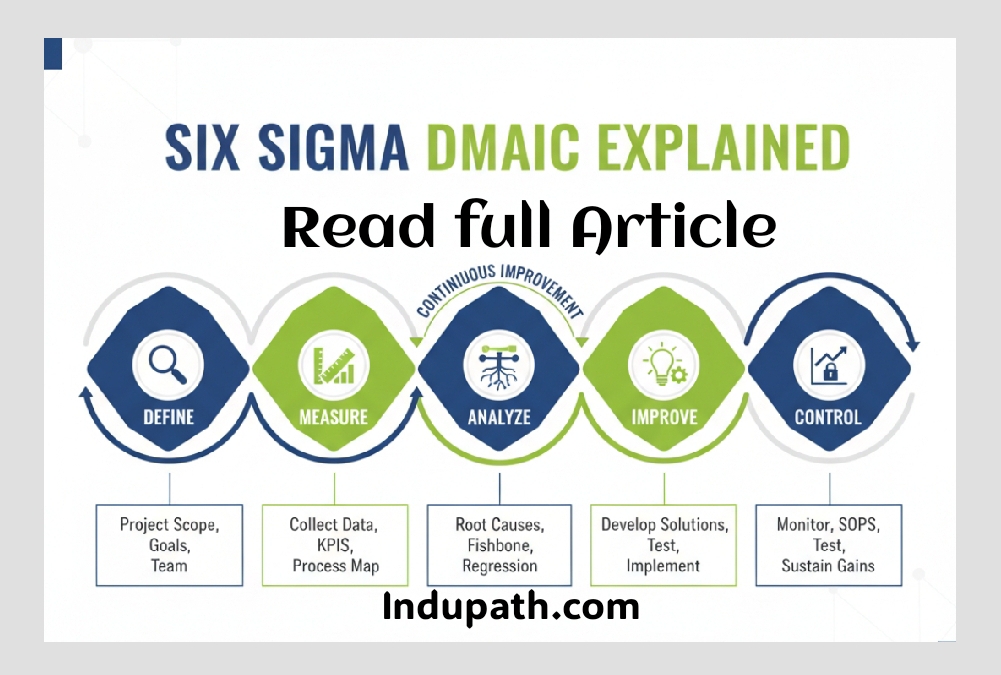
DMAIC stands for Define, Measure, Analyze, Improve, and Control. These five phases guide a project from problem identification to long-term process control. Instead of applying quick fixes, DMAIC ensures that the real root cause is found, tested, and permanently eliminated. This disciplined approach is what makes Six Sigma different from traditional trial-and-error improvement methods.
At the core of the Six Sigma methodology lies a structured, data-driven improvement cycle known as DMAIC —
Define, Measure, Analyze, Improve, and Control.
This framework provides a systematic approach to identifying problems, understanding their root causes, implementing solutions, and ensuring long-term stability. Whether you’re a Quality Engineer, Production Supervisor, Maintenance Manager, Business Analyst, or even a student, understanding DMAIC is essential to building a strong foundation in Six Sigma.
This article explains the DMAIC framework, tools used in each phase, real-world examples, and why Six Sigma continues to be one of the most effective quality improvement structures.

What is Six Sigma?
Six Sigma is a data-driven methodology aimed at reducing variation, minimizing defects, and improving process capability. The goal is to reach a quality level where defects are limited to 3.4 defects per million opportunities (DPMO) — representing near-perfection.
Six Sigma focuses on:
- Improving customer satisfaction
- Reducing process waste and errors
- Enhancing productivity
- Strengthening decision-making through data
- Standardizing high-quality processes
The most widely used roadmap in Six Sigma is the DMAIC cycle, applicable to almost every industry.
The DMAIC Methodology Explained
DMAIC is a structured approach used in Six Sigma projects. Each phase uses specific tools, data-driven techniques, and deliverables.
1. Define Phase – Identifying the Problem Clearly
In the Define phase, the problem is clearly described from the customer’s point of view. The team identifies what is going wrong, why it matters to the business, and what success will look like. Tools like SIPOC, Voice of Customer, and Project Charter help in setting clear goals and boundaries so everyone works toward the same objective.
Objectives of the Define Phase
- Understand the business problem
- Identify project goals
- Define customer expectations
- Establish project boundaries
- Form the project team
Key Tools Used
- Project Charter
- SIPOC Diagram (Supplier-Input-Process-Output-Customer)
- Voice of Customer (VOC)
- CTQ (Critical to Quality) Tree
- High-Level Process Map
Output of the Define Phase
A clear and well-defined problem statement, scope, and project objective.
2. Measure Phase – Quantifying the Problem
In the Measure phase, the team gathers data to understand the current process performance. The Measure phase focuses on understanding the current performance of the process. Actual data is collected to establish a baseline and to verify how often defects occur. This step removes guesswork and provides a factual picture of where the process stands, using metrics such as defect rate, cycle time, and process capability.
Objectives of the Measure Phase
- Identify key process metrics
- Validate measurement systems
- Identify defects and frequency
- Establish baseline performance
Key Tools Used
- Data Collection Plan
- Process Flow Chart
- Measurement System Analysis (MSA)
- Gauge R&R
- Baseline Process Capability (Cp, Cpk)
Output of the Measure Phase
A reliable dataset with baseline metrics such as DPMO, sigma level, and cycle time.
3. Analyze Phase – Finding Root Causes
In the Analyze phase, the team identifies the true root causes of the problem. During the Analyze phase, the collected data is studied to identify patterns and uncover the true root causes of problems. Techniques such as Fishbone diagrams, Pareto analysis, and hypothesis testing are used to separate symptoms from causes. This phase ensures that improvement efforts target the real sources of variation and waste.
Objectives of the Analyze Phase
- Identify patterns and trends
- Perform statistical analysis
- Validate root causes using data
Key Tools Used
- Fishbone (Ishikawa) Diagram
- 5 Why Analysis
- Pareto Chart
- Regression Analysis
- Hypothesis Testing (t-test, ANOVA)
- FMEA (Failure Mode & Effects Analysis)
Output of the Analyze Phase
A validated list of root causes impacting the process.
🚀 Checkout These Career-Boost Kits
- 📘 APQP Document 100+ – Click Here
- 📊 Production PPC 90+ Documents PPT – Click Here
- 📑 Six Sigma Format – Click Here
- 🎯 Dream Job Kit – Click Here
- 📂 60+ PPT Pack – Click Here
- 🗂️ HR Formats 100000+ – Click Here
- ✅ ISO 9001:2015 Toolkit – Click Here
- ⚙️ IATF (A–Z All Formats) – Click Here
- 📄 Resume Templates 700+– Click Here
4. Improve Phase – Implementing the Solutions
Once the root causes are identified, this phase focuses on developing and implementing solutions. The Improve phase is where solutions are developed and tested. Based on the confirmed root causes, teams design changes, run pilot trials, and optimize process settings. Lean tools, mistake-proofing methods, and controlled experiments help in achieving measurable improvement in quality, cost, and delivery.
Objectives of the Improve Phase
- Generate improvement ideas
- Test and validate solution
- Implement process improvements
- Optimize performance
Key Tools Used
- Brainstorming & Idea Prioritization
- DOE (Design of Experiments)
- Kaizen & 5S
- Poka-Yoke (Error Proofing)
- Pilot Testing
- Cost-Benefit Analysis
Output of the Improve Phase
Improved process performance with validated solutions and reduce defects.
5. Control Phase – Sustaining the Improvements
In the Control phase, the new process is standardized to ensure improvements do not fade over time. Finally, the Control phase ensures that the gains are sustained over time. Standard procedures are updated, control charts are implemented, and operators are trained to maintain the new process conditions. Continuous monitoring prevents the process from drifting back to its old performance levels.
Objectives of the Control Phase
- Establish control mechanisms
- Monitor process performance
- Implement standard operating procedurs (SOPs)
- Train teams and stakeholders
Key Tools Used
- Control Charts
- SPC (Statistical Process Control)
- Process Control Plan
- Documentation Updates
- Handover Checklist
Output of the Control Phase
Stable and controlled processes with long-term sustainability.
Real-World Example of DMAIC
Problem:
High rejection rate in a machining operation for an automotive component.
Using DMAIC:
- Define: Identify defect (dimension out of tolerance), project charter created.
- Measure: Collect data — rejection rate = 7%.
- Analyze: Root cause found: tool wear and inconsistent cutting speed.
- Improve: Optimized tool change frequency and set standard cutting parameters.
- Control: SPC charts implemented → rejection rate dropped to 1.2%.
Benefits of DMAIC in Six Sigma
- Reduced variation and defects
- Increased customer satisfaction
- Waste elimination and cost reduction
- Faster turnaround time
- Enhanced productivity and efficiency
- Strong data-driven decision-making
- Better cross-functional collaboration
Frequently Asked Questions (FAQs)
1. What does DMAIC stand for?
DMAIC stands for Define, Measure, Analyze, Improve, and Control — the five phases of the Six Sigma improvement cycle.
2. Is DMAIC used only in manufacturing?
No. DMAIC is used in healthcare, IT, logistics, finance, customer service, supply chain, and more.
3. What is the main goal of Six Sigma DMAIC?
To eliminate defects, reduce variation, and improve process performance using data-driven techniques.
4. Is DMAIC the same as PDCA?
Both are improvement cycles, but DMAIC is more structured, data-intensive, and statistically driven.
5. Do I need certification to use DMAIC?
Certification helps but is not mandatory. Many organizations train internal employees to use DMAIC tools.
The Six Sigma DMAIC methodology is one of the most effective frameworks for improving process performance and driving operational excellence. By following a structured, data-driven approach — Define, Measure, Analyze, Improve, and Control — organizations can achieve significant reductions in waste, defects, and cost while improving quality and customer satisfaction.
Whether you are a beginner, a manager, or a professional preparing for Six Sigma certification, mastering DMAIC is the first step toward becoming a skilled quality leader.