
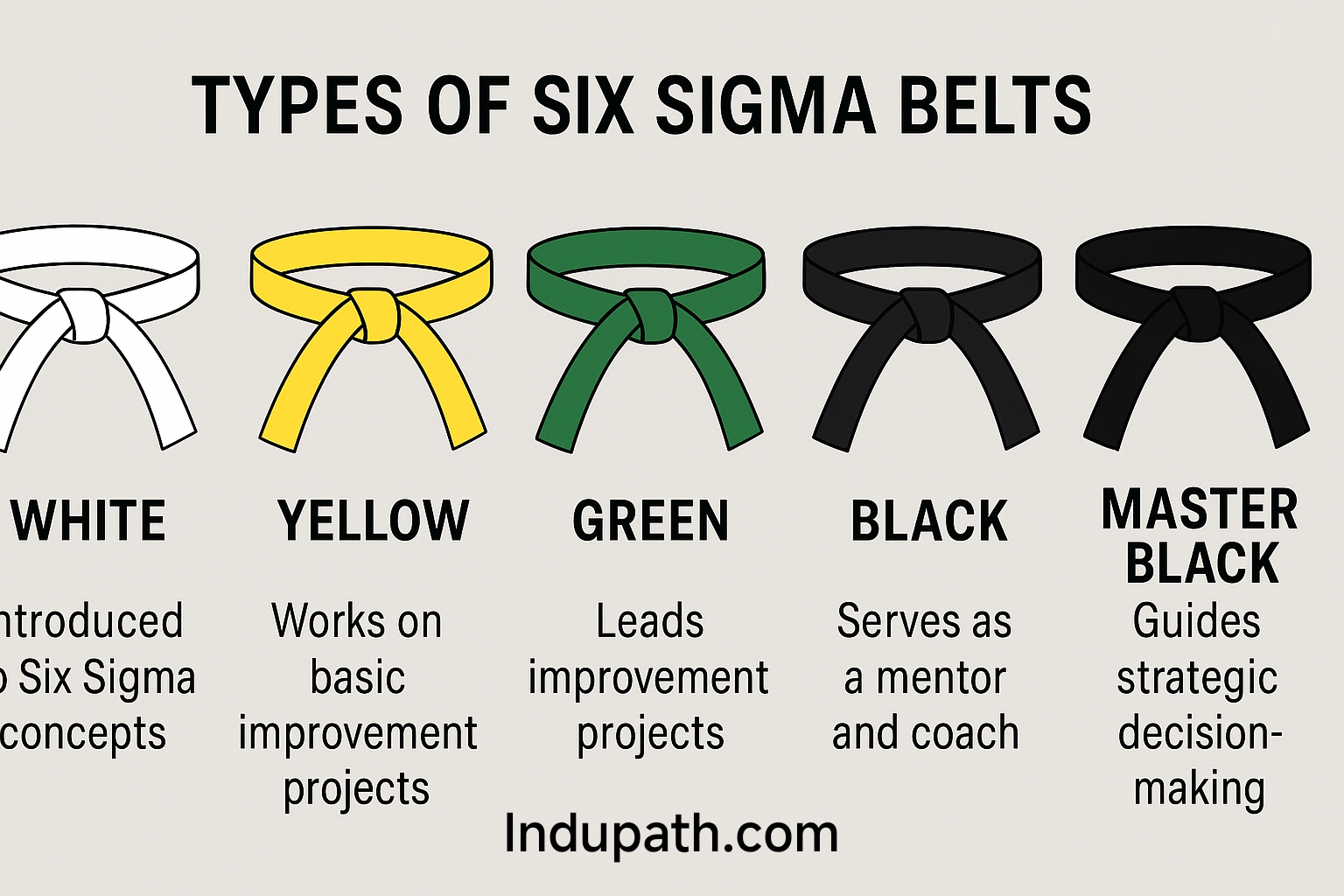
Types of Six Sigma Belts: White, Yellow, Green, Black & Master Black Belt Explained
Learn about the types of Six Sigma belts—White, Yellow, Green, Black, and Master Black Belt—with roles, responsibilities, skills, and career benefits.
Six Sigma is one of the world’s most recognized methodologies for improving quality, reducing variation, eliminating defects, and enhancing process performance. To create a structured improvement culture, Six Sigma uses a “belt” system similar to martial arts.
Each belt level represents a specific skillset, responsibility, and depth of knowledge—from beginners who support small improvements to experts who lead organization-wide transformation.
This article clearly explains all Types of Six Sigma Belts—White, Yellow, Green, Black, and Master Black Belt—so you can understand which certification fits your career path.
🥋 1. Six Sigma White Belt
Who is a White Belt?
A White Belt is an entry-level professional who has basic awareness of Lean and Six Sigma concepts. No prior experience or mathematics knowledge is required.
Key Responsibilities:
- Understand basic Six Sigma terminology
- Support local problem-solving teams
- Participate in waste identification activities
- Assist Yellow/Green Belt team members when required
- Learn foundation concepts: waste (TIMWOOD), variation, CTQ, VOC
Best For:
Freshers, operators, office staff, supervisors, and anyone new to continuous improvement.
🟨 2. Six Sigma Yellow Belt
Who is a Yellow Belt?
A Yellow Belt has a deeper understanding of Lean Six Sigma concepts and can assist in DMAIC projects. They often work as team members on Green/Black Belt projects.
Key Responsibilities:
- Participate in DMAIC phases
- Support data collection
- Run basic process maps and flowcharts
- Identify waste and assist with Kaizen
- Help maintain process standards and 5S
Skills Learned:
- Basic root-cause tools (Fishbone, Pareto, 5 Why)
- Process mapping
- Understanding of variation and basic metrics
Best For:
Team leaders, quality inspectors, supervisors, coordinators.
🟩 3. Six Sigma Green Belt
Who is a Green Belt?
A Green Belt is a project-level leader who runs medium-scale improvement projects using DMAIC. They work part-time on improvement while continuing their regular job.

Key Responsibilities:
- Lead improvement projects
- Collect and analyze data
- Perform statistical analysis
- Reduce defects / cost / process delays
- Collaborate cross-functionally
- Use Lean tools + Six Sigma tools together
Key Skills:
- Minitab or data analysis tools
- Hypothesis testing (t-test, chi-square, ANOVA)
- FMEA, Control Charts, Process Capability (Cp, Cpk)
- Value Stream Mapping
- Problem-solving and project leadership
Best For:
Quality engineers, manufacturing engineers, process analysts, team leaders, supply chain & operations professionals.
🟦 4. Six Sigma Black Belt
Who is a Black Belt?
A Black Belt is a full-time improvement expert who leads high-impact, complex DMAIC projects and mentors Green Belts. They drive strategic improvements across departments.
Key Responsibilities:
- Lead high-value improvement projects
- Solve complex business problems
- Perform advanced statistical analysis
- Drive cross-functional collaboration
- Support Lean transformations
- Mentor and train Yellow/Green Belts
- Present project results to leadership
Advanced Skills:
- Design of Experiments (DOE)
- Regression, correlation, capability studies
- Root cause deep analysis
- Project management and change management
- Lean flow optimization
- Advanced Minitab usage
Best For:
Experienced quality engineers, project managers, operations leaders, production managers, and analysts aiming for senior roles.
🟥 5. Six Sigma Master Black Belt (MBB)
Who is an MBB?
A Master Black Belt is the highest expert in Six Sigma. They define strategy, coach Black Belts, and guide leadership in continuous improvement culture building.
Key Responsibilities:
- Lead enterprise-wide transformation
- Set Six Sigma roadmap and strategy
- Select and prioritize improvement projects
- Coach Black Belts and Green Belts
- Train Lean Six Sigma programs
- Build analytics capability in the organization
- Engage with leadership for long-term planning
Expert Skills:
- Advanced statistics
- Business case development
- Organizational change leadership
- Lean system deployment
- Data-driven decision making
- Strategic resource planning
Best For:
Senior leaders, quality heads, operational excellence managers, consultants, transformation leaders.
🔻 Six Sigma Belt Hierarchy Summary
| Belt Level | Knowledge Depth | Project Role | Typical Impact |
|---|---|---|---|
| White | Basic awareness | Support teams | Waste identification |
| Yellow | Fundamental concepts | Team member | Data collection, mapping |
| Green | Intermediate | Project leader | Mid-level improvements |
| Black | Advanced | Cross-functional leader | High-value strategic projects |
| Master Black Belt | Expert | Enterprise coach | Organization-wide transformation |
🎯 Which Six Sigma Belt Should You Choose?
Six Sigma has become one of the most respected career-enhancing certifications across manufacturing, IT, healthcare, service, logistics, supply chain, BPO, consulting, and analytics. But with multiple belt levels—White, Yellow, Green, Black, and Master Black Belt—professionals often ask:
👉 Which Six Sigma Belt Should I Choose?
👉 Which belt is right for my experience level?
👉 Where should I start to grow my career?
This guide simplifies the decision so you can confidently select the right Six Sigma belt to match your goals, skills, and industry expectations.
- If you are a beginner → White or Yellow Belt
- If you want to lead projects → Green Belt
- If you want to be a full-time improvement expert → Black Belt
- If you want to lead enterprise-level transformation → Master Black Belt
Below is a detailed, practical guide to help you select the ideal Six Sigma belt based on:
- Your job role
- Your years of experience
- Your industry
- Your career goals
- Your learning preferences
- Your expected salary growth
🥋 1. Choose White Belt If You Are a Beginner or Student
✔ Best For:
- Students
- Freshers
- Operators
- Office staff
- Anyone completely new to Lean Six Sigma
✔ Why Choose White Belt?
- Gives basic terminology
- Helps understand what Lean Six Sigma is
- No technical/statistical requirements
- Helps you participate in small improvement activities
✔ Choose This If:
You want awareness, not deep problem-solving.
🚀 Checkout These Career-Boost Kits
- 📘 APQP Document 100+ – Click Here
- 📊 Production PPC 90+ Documents PPT – Click Here
- 📑 Six Sigma Format – Click Here
- 🎯 Dream Job Kit – Click Here
- 📂 60+ PPT Pack – Click Here
- 🗂️ HR Formats 100000+ – Click Here
- ✅ ISO 9001:2015 Toolkit – Click Here
- ⚙️ IATF (A–Z All Formats) – Click Here
- 📄 Resume Templates 700+– Click Here
🟨 2. Choose Yellow Belt If You Work in an Operational or Support Role
✔ Best For:
- Team leaders
- Supervisors
- QC/QA technicians
- Administrative and service roles
✔ Why Choose Yellow Belt?
- Foundation of DMAIC methodology
- Learn basic problem-solving tools
- Participate as an effective project team member
✔ Skills You Gain:
- 5 Why
- Fishbone Diagram
- Basic data collection
- Process mapping
✔ Choose This If:
You want to support improvement projects but not lead them.
🟩 3. Choose Green Belt If You Want to Lead Improvement Projects
(Most Popular Belt)
✔ Best For:
- Quality engineers
- Production engineers
- Process engineers
- Manufacturing professionals
- IT analysts
- Supply chain & operations teams
- BPO / service / logistics roles
- Anyone targeting mid-level technical jobs
✔ Why Choose Green Belt?
- You learn complete DMAIC
- You lead medium-scale projects
- High demand across industries
- Helps in promotions and salary hikes
✔ Skills You Gain:
- Data analysis
- Hypothesis testing
- Minitab basics
- FMEA, Control Charts
- Root cause analysis
✔ Choose This If:
You want to grow into Quality, Process Improvement, Operations, or Project Management roles.
🟥 4. Choose Black Belt If You Want to Become an Expert or Team Leader
✔ Best For:
- Senior engineers
- Project managers
- Quality managers
- Operations managers
- Consultants
- Analysts with 5+ years of experience
✔ Why Choose Black Belt?
- Become a full-time improvement specialist
- Lead cross-functional teams
- Solve high-impact business problems
- Guide Green Belts
- Drive Lean transformations
✔ Skills You Gain:
- Advanced statistics
- Design of Experiments (DOE)
- Regression, ANOVA, capability studies
- Change management
- Leadership and coaching
✔ Choose This If:
You want high-level roles like:
- Quality Manager
- Process Excellence Manager
- Operational Excellence Specialist
- Lean Six Sigma Trainer
🟦 5. Choose Master Black Belt If You Want to Become a Transformation Leader
✔ Best For:
- Senior managers
- Opex heads
- Directors
- Corporate trainers
- Enterprise consultants
✔ Why Choose MBB?
- You create Six Sigma strategy
- Mentor Black Belts
- Manage multiple improvement portfolios
- Work directly with top leadership
✔ Skills You Gain:
- Business transformation
- Strategic planning
- Enterprise risk analysis
- Coaching frameworks
✔ Choose This If:
Your goal is to become a corporate-level leader, consultant, or head of operational excellence.
🧭 Which Belt Should YOU Choose Based on Your Experience?
- If you have 0–1 year experience → White / Yellow Belt
- If you have 1–5 years experience → Green Belt
- If you have 5–10 years experience → Black Belt
- If you have 10+ years experience → Master Black Belt
🏭 Based on Industry
| Industry | Recommended Belt |
|---|---|
| Manufacturing | Green → Black |
| Quality/QA/QC | Green → Black |
| Automotive | Green → Black |
| Supply Chain | Green |
| IT/Software | Yellow → Green |
| BPO/Service | Yellow → Green |
| Healthcare | Yellow → Green |
| Senior Leadership | Black → Master Black |
💰 Salary Growth by Belt Level (Approx India Figures)
| Belt | Salary Range |
|---|---|
| White Belt | ₹2–4 LPA |
| Yellow Belt | ₹3–6 LPA |
| Green Belt | ₹5–12 LPA |
| Black Belt | ₹10–25 LPA |
| Master Black Belt | ₹20–40+ LPA |
Each belt provides the foundation for the next stage, helping professionals build strong problem-solving, analytical, and leadership capabilities.
Understanding the Types of Six Sigma Belts helps professionals choose the right certification for career growth. Whether you are starting with White Belt or aiming for Master Black Belt, Six Sigma provides the skills and mindset needed to solve problems, reduce defects, improve efficiency, and deliver measurable business impact.
Lean Six Sigma remains one of the most respected frameworks for building a culture of continuous improvement and operational excellence.
Types of Six Sigma Belts, Six Sigma belt levels, Six Sigma certification levels, White belt role, Yellow belt responsibilities, Green belt vs Black belt, Master Black Belt duties, Lean Six Sigma belts, Six Sigma hierarchy, Six Sigma career growth, Six Sigma, Lean Six Sigma, Six Sigma Belts, White Belt, Yellow Belt, Green Belt, Black Belt, Master Black Belt, Continuous Improvement, Quality Management, Lean, DMAIC, Operational Excellence, Process Improvement topic covered.
10 Questions and Answers
(For Six Sigma Certifications, Belt Selection & Career Planing)
1. What factors should someone consider before choosing a Six Sigma Belt level?
Answer:
A person should evaluate their current experince, career goals, industry expectations, and time availability. Beginners should start with White or Yellow Belt. Professionals aiming for problem-solving roles can choose Green Belt, while those targeting leadership or project ownership should pursue Black Belt or Master Black Belt.
2. Who should start with a Six Sigma White Belt?
Answer:
The White Belt is ideal for freshers, entry-level employes, or individuals who want basic awareness of Six Sigma concepts without managing projects. It helps them understand the language of quality improvement and participate in basic problem-solving discussions.
3. When is a Six Sigma Yellow Belt the right choice?
Answer:
A Yellow Belt is best for those who want a supporting role in Six Sigma projects. Candidates who collaborate with project teams or want to grow into quality roles should choose this belt. It strengthens understanding of DMAIC tools and team contributions.
4. What type of professionals benefit most from a Six Sigma Green Belt?
Answer:
Green Belt is suitable for engineers, analysts, supervisors, and mid-level managers who want to lead improvement projects. It prepares them to analyze data, solve complex problems, and drive cost reduction and efficiency improvements in teams.
5. Why should someone choose a Six Sigma Black Belt?
Answer:
Black Belt is ideal for individuals who want to become quality leaders, project managers, or process optimization experts. It provides advanced statistical, analytical, and leadership skills to manage cross-functional improvement projects and mentor Green Belts.
6. What makes the Master Black Belt suitable only for experienced professionals?
Answer:
Master Black Belt requires deep Six Sigma knowledge, years of experience, and the ability to train and coach other belts. It focuses on strategic leadership, organizational transformation, and enterprise-level quality planning, making it appropriate only for senior professionals.
7. Can someone directly take a Green Belt without doing Yellow Belt?
Answer:
Yes. Most certification bodies allow candidates to start directly with Green Belt. However, having prior exposure to Yellow Belt concepts ensures easier understanding of DMAIC and basic tools.
8. What belt level is most beneficial for career growth in manufacturing and quality roles?
Answer:
Green Belt and Black Belt certifications provide the highest career value in manufacturing, automotive, aerospace, and industrial sectors. These belts demonstrate strong analytical and process improvement capabilities.
9. Which Six Sigma Belt is recommended for professionals from non-technical backgrounds?
Answer:
Yellow Belt or Green Belt is suitable for non-technical professionals such as HR, finance, supply chain, and operations. These belts help them apply structured problem-solving in their functional areas without requiring heavy statistical knowledge initially.
10. How should someone decide between choosing a Lean Six Sigma and a Traditional Six Sigma belt?
Answer:
Choose Lean Six Sigma if you want to focus on speed, waste reduction, and process flow. Choose Traditional Six Sigma if your role demands data-heavy analysis, quality control, and defect reduction. Many professionals prefer Lean Six Sigma because it combines both methodologies for practical improvement.
For professionals who want to go deeper into Lean Six Sigma and build strong practical knowledge, having access to structured, industry-focused learning resources is very important. At InduPath.com, you can find detailed guides on Six Sigma, Lean tools, DMAIC, quality management, TPM, 5S, and continuous improvement practices, all explained in a simple and application-oriented manner. These resources help engineers, managers, and students connect theory with real-world implementation and strengthen their skills for certification as well as career growth. By exploring related articles and learning paths on InduPath, readers can develop a complete understanding of how Lean Six Sigma is applied across manufacturing and service industries.
🚀 Checkout These Career-Boost Kits
- 📘 APQP Document 100+ – Click Here
- 📊 Production PPC 90+ Documents PPT – Click Here
- 📑 Six Sigma Format – Click Here
- 🎯 Dream Job Kit – Click Here
- 📂 60+ PPT Pack – Click Here
- 🗂️ HR Formats 100000+ – Click Here
- ✅ ISO 9001:2015 Toolkit – Click Here
- ⚙️ IATF (A–Z All Formats) – Click Here
- 📄 Resume Templates 700+– Click Here